By Mira Chen — This guide tracks a zero-spending alt account from the very first day on July 1st, mapping out the exact first eight weeks of Heartopia without spending a single cent. With 340+ hours on a main account and all hobbies maxed, playing from absolute scratch on the alt was the most revealing way to understand how the progression systems actually interlock. This guide collects everything a new player wishes they had been told before planting the first tomato and wondering why gold was not growing fast enough.
- Understanding the Core Systems
- The First Hour: Day One Priorities
- The Economy: Gold, Wishing Stars, and How to Earn
- Unlocking Hobbies: Order, Mentors, and Tickets
- Daily Routine: What Every F2P Player Should Do Every Day
- The Bubble System: Free Items Around the Map
- Foraging and Resource Collection
- F2P Expansion Timeline
- The Neighborhood Community System
- Key NPCs Every New Player Should Know
- Frequently Asked Questions (FAQ)
- Related Guides
- About the Author
- Join the Heartopia Community on Discord
- Related Heartopia Guides
[July 25, 2026 | Beginner Guide]
Understanding the Core Systems
Heartopia’s progression is built around two central organizations that govern almost everything a player does. Understanding these before making a first decision saves days of wasted effort.
The Development Guild (D.G.) System
The Development Guild — or D.G. — is the backbone of the entire progression system. Players complete daily commissions (Resident Requests) for NPCs around town, and each one awards Contribution Medals. These medals feed into the player’s D.G. level. As the D.G. level rises, players unlock new plot slots for the garden, receive Hobby Expansion Tickets to unlock additional hobbies, and gain access to expanded functionality across the game.
Think of D.G. level as the all-purpose progression rank. Every system in the game checks it before unlocking something new. Ignoring D.G. level on a main account for the first week while exploring can lock a player out of a second hobby for an extra three days, purely from not completing enough daily commissions. On a free-to-play alt, treating commissions as the very first task every session reached the hobby unlock threshold two full days earlier.
The Heritage Association
The Heritage Association handles the main story questline. Following the main story introduces key NPCs, unlocks new areas, and progresses the plot. Grandpa Duke gives starter tools early in the main story. Annie appears as a central character in the main questline. It is best to push the main story forward at least through the first few chapters before diving deep into any single hobby — the story unlocks area access needed for certain insects and fish.
The First Hour: Day One Priorities
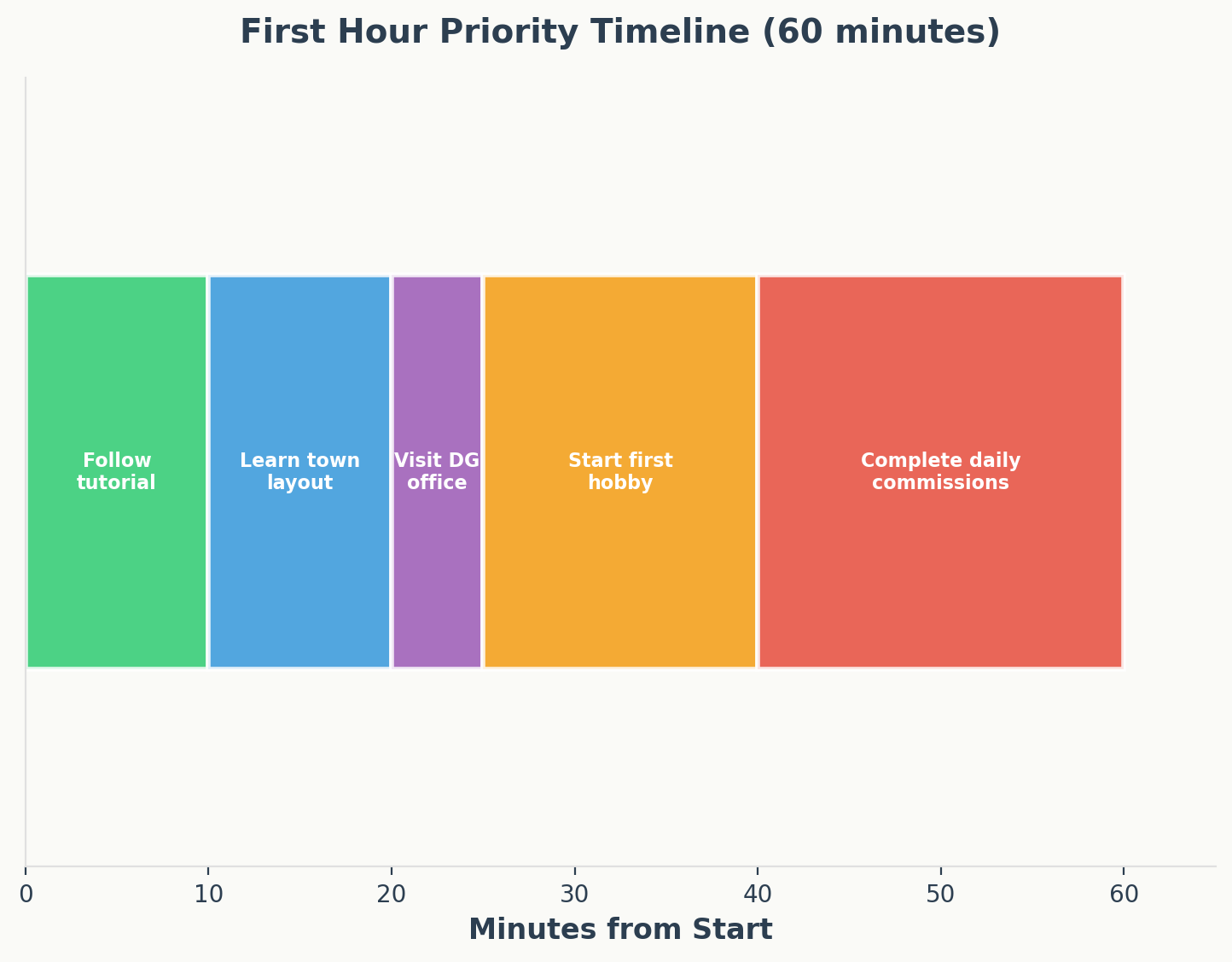
The game drops a new player into a small cabin and walks through the initial tutorial. Following this exact sequence on a fresh alt account produces the strongest possible start:
| Step | Action | Why |
|---|---|---|
| 1 | Follow the main story tutorial | Unlocks the Heritage Association questline, introduces Grandpa Duke’s tool gifts |
| 2 | Learn the town layout | Walk through Town Square, Garden Street, and the Fishing Village |
| 3 | Visit the Development Guild office | Understand the commission system and the first batch of daily commissions |
| 4 | Start the first hobby | Gardening or Fishing recommended — see the hobby section below |
| 5 | Complete available daily commissions | Earn the first Contribution Medals to start D.G. progress |
| 6 | Plant the first crops if gardening is chosen | Crops grow in real time — every hour delayed is income lost |
Players start with 2 plot slots in the garden. That sounds small, but it is enough to establish an income baseline while D.G. levels are raised for more. On a fresh alt, planting tomatoes immediately — at 40 gold per harvest on a 15-minute cycle — offers the highest hourly gold rate of any early crop, with profits reinvested into seeds within the first hour.
The Economy: Gold, Wishing Stars, and How to Earn
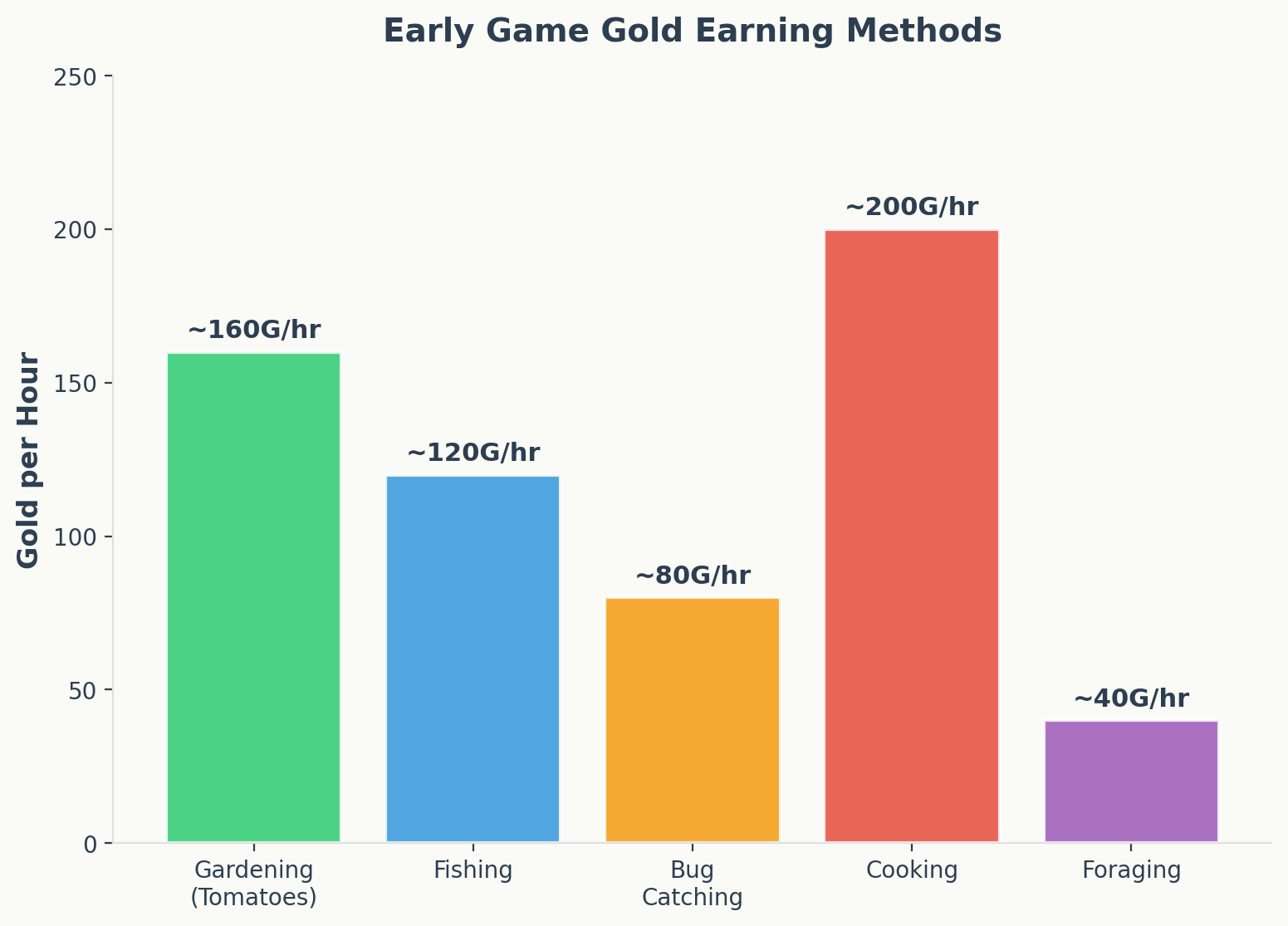
Heartopia has two currencies. Gold is the primary currency a player will spend on seeds, tools, hobby equipment, and recipes. Wishing Stars are the premium currency, but they are earnable through gameplay — the weekly Home Rating evaluation rewards Wishing Stars alongside furniture pieces, so F2P players do accumulate them naturally over time.
Gold Income Sources (Ranked by Early-Game Value)
| Source | Income Rate | Notes |
|---|---|---|
| Gardening (Tomatoes) | ~40 gold / 15 min per plot | Highest hourly return among early crops |
| Fishing | Variable by species | Vanya teaches the basics; sea fish via Bill sell for more |
| Bug Catching | Sell common insects | Lang Hua in the city area; rare insects sell well at 4-5 stars |
| Cooking | Multiplies raw ingredient value | Massimo is the cooking mentor — requires ingredients first |
| Foraging | Free materials (wood, apples, stone, herbs) | Available from the start; no hobby needed |
| Daily Commissions | Fixed gold + medals | Always complete these every day |
The key insight across two accounts: gardening is the income foundation, and everything else builds on top of it. Tomatoes mature in 15 minutes and sell for around 40 gold per harvest per plot. With just 2 initial plots running tomatoes on a loop, a player generates gold faster than any other hobby can at level 1. Once more plot slots are unlocked through D.G. levels, that income scales linearly.
Unlocking Hobbies: Order, Mentors, and Tickets
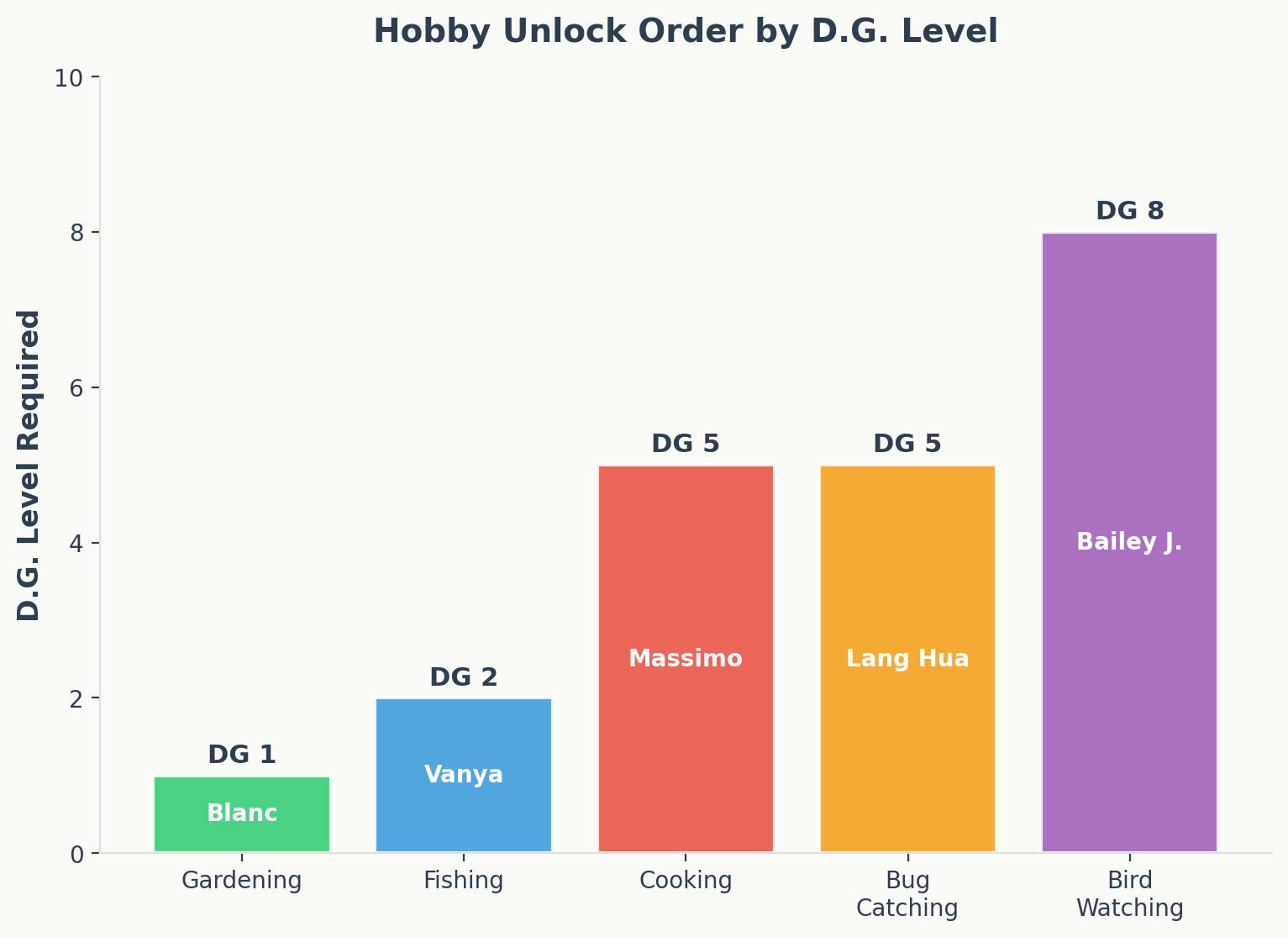
Heartopia has seven hobbies in total, each unlocked through the Development Guild (D.G.) system using Hobby Expansion Tickets:
| Hobby | Mentor | Location | D.G. Level for Ticket | Notes |
|---|---|---|---|---|
| Gardening | Blanc | Garden Street area | D.G. 3 | Free basic access from tutorial; full expansion via ticket |
| Fishing | Vanya | Garden Street (blue hair) | D.G. 2 | Earliest unlockable hobby after tutorial gardening |
| Cooking | Massimo | Town area | D.G. 5, 8, or 11 | Requires ingredients from gardening and fishing first |
| Bug Catching | Lang Hua | City area / Lang Hua Garden | D.G. 5, 8, or 11 | Unlock after main story level 5-7 via Annie |
| Bird Watching | Bailey J. | Town center | D.G. 5, 8, or 11 | Completion/collection hobby; minimal gold income |
| Cat Care | Ms. Joan (Ms. Joan) | Pet area | D.G. 12 | Adopt and care for a cat at the Pet House |
| Dog Care | Ms. Joan (Ms. Joan) | Pet area | D.G. 12 + Cat Care | Requires completing Cat Care basics first; 8 dog breeds available |
Recommended Unlock Order (F2P Perspective)
Testing multiple sequences on an alt account, this is the order that produced the most stable income by week two:
1. Gardening first (D.G. 3 ticket → Blanc) — Income foundation. Nothing else pays without crops. Basic gardening comes from the tutorial; the D.G. 3 ticket is used for full expansion.
2. Fishing second (D.G. 2 ticket → Vanya) — Vanya has blue hair and stands on Garden Street. Fish sell well raw, and even better cooked. This is actually the earliest ticket that can be earned.
3. Bug Catching third (D.G. 5 ticket → Lang Hua) — Lang Hua is the bug-catching mentor. Find her at Lang Hua Garden after progressing the main story to level 5-7 via Annie. Common insects provide supplementary income.
4. Cooking fourth (D.G. 5+ ticket → Massimo) — Wait until there is a steady supply of garden vegetables and fish before unlocking cooking. Massimo multiplies raw ingredients into dishes worth 2-3x more gold.
5. Bird Watching fifth (D.G. 5+ ticket → Bailey J.) — Talk to Bailey J. in the town center. This is a collection hobby: photograph birds to fill a bird encyclopedia. It produces minimal gold but is satisfying for completionists.
6. Cat Care sixth (D.G. 12 ticket → Ms. Joan) — A late-game hobby. Adopt and care for a cat at the Pet House. Mostly a lifestyle/companion feature, not a gold source.
7. Dog Care seventh (D.G. 12 ticket → Ms. Joan, after Cat Care) — The final hobby. Cat Care basics must be completed first. Eight dog breeds are available: Husky, Shepherd, Country Dog, Golden Retriever, Labrador, Beagle, Dalmatian, and Shiba Inu.
Hobby Expansion Tickets come from the Development Guild. Players do not spend gold on hobby unlocks — they earn them by completing enough daily commissions and raising the D.G. level. This is why commissions are constantly emphasized: they are the gateway to everything.
Sea Fishing (through Bill in the Fishing Village) is not a separate hobby — it is an event-based activity within the fishing system. Bill offers boat trips that unlock exclusive deep-sea species. A separate expansion ticket is not needed; once the fishing level is high enough to handle the tougher fights, players can simply talk to Bill.
Hobby Level Cap
All hobbies have a level cap of 12. Levels 1 through 10 use standard upgrade materials. Levels 10 to 12 require Advanced Hobby Upgrade Vouchers, which are rewarded when the Development Guild level reaches 50. This means early-game players should not worry about maxing hobbies quickly — just focus on steady daily progress.
Daily Routine: What Every F2P Player Should Do Every Day
After the first few days, a daily session should settle into this checklist. From a pure F2P perspective, every item on this list costs zero premium currency:
1. Complete daily commissions — These give Contribution Medals and gold. Medals feed D.G. level, which unlocks everything else. Do these first.
2. Water and harvest crops — Missed watering delays harvest. Replant immediately after harvesting to keep the income cycle going.
3. Check reward bubbles — These refresh approximately every 4 hours. They contain free items, gold, and occasional premium currency. This is worth doing whenever logging in.
4. Check NPC shop rotations — NPCs refresh their inventories on a schedule. Blanc sometimes stocks rare seeds, and Bill’s fishing shop rotates bait availability.
5. Submit Home Rating before Saturday — The weekly Home Rating evaluation rewards furniture and Wishing Stars. Make sure the home has enough placed furniture to score well before the Saturday deadline.
The Bubble System: Free Items Around the Map
While exploring the world, players will notice floating bubbles scattered across the map. Tapping these bubbles gives free items — clothing pieces, crafting recipes, and occasionally small amounts of gold or premium currency. Bubbles refresh on a regular schedule.
– Regular bubbles (white/blue): Contain common clothing items and basic recipes. These are scattered everywhere and easy to find during normal exploration.
– Pink bubbles: Refresh weekly at fixed locations (approximately 15 per week). They can contain full clothing sets and higher-value items. Community posts track the weekly pink bubble locations for players who want to collect them all efficiently.
– Purple bubbles: Rare hidden bubbles that contain exclusive clothing sets and premium recipes. These are harder to find — they often appear in out-of-the-way corners and change locations. Check community guides for current purple bubble locations.
It helps to check for bubbles whenever transitioning between areas during a daily session. Over a week, the cumulative free items add up to a meaningful amount of clothing and recipe content that would otherwise require spending gold or Wishing Stars.
Foraging and Resource Collection
Beyond the structured hobbies, Heartopia has a passive resource collection system. While exploring the map, players can pick up free materials that are used for crafting, building, and cooking:
– Trees: Shake trees to collect wood, tree branches (needed for fishing rod repair), and occasional fruit (Apples, Oranges, etc.)
– Rocks/Stone deposits: Mine stone and ore for building materials and crafting
– Wild herbs and flowers: Found throughout the map, used in some cooking recipes
– Beach combing: Walk along the sandy beaches to find shells and coastal materials
These resources do not require any hobby unlocked — they are available from the start. A useful habit is shaking every tree and checking every rock along the daily travel routes. The free Apples from trees are especially valuable early on because they are the crafting material for Normal Fishing Bait (2 Apples per bait). Foraging costs zero gold and provides the raw materials needed to get started with multiple systems.
F2P Expansion Timeline
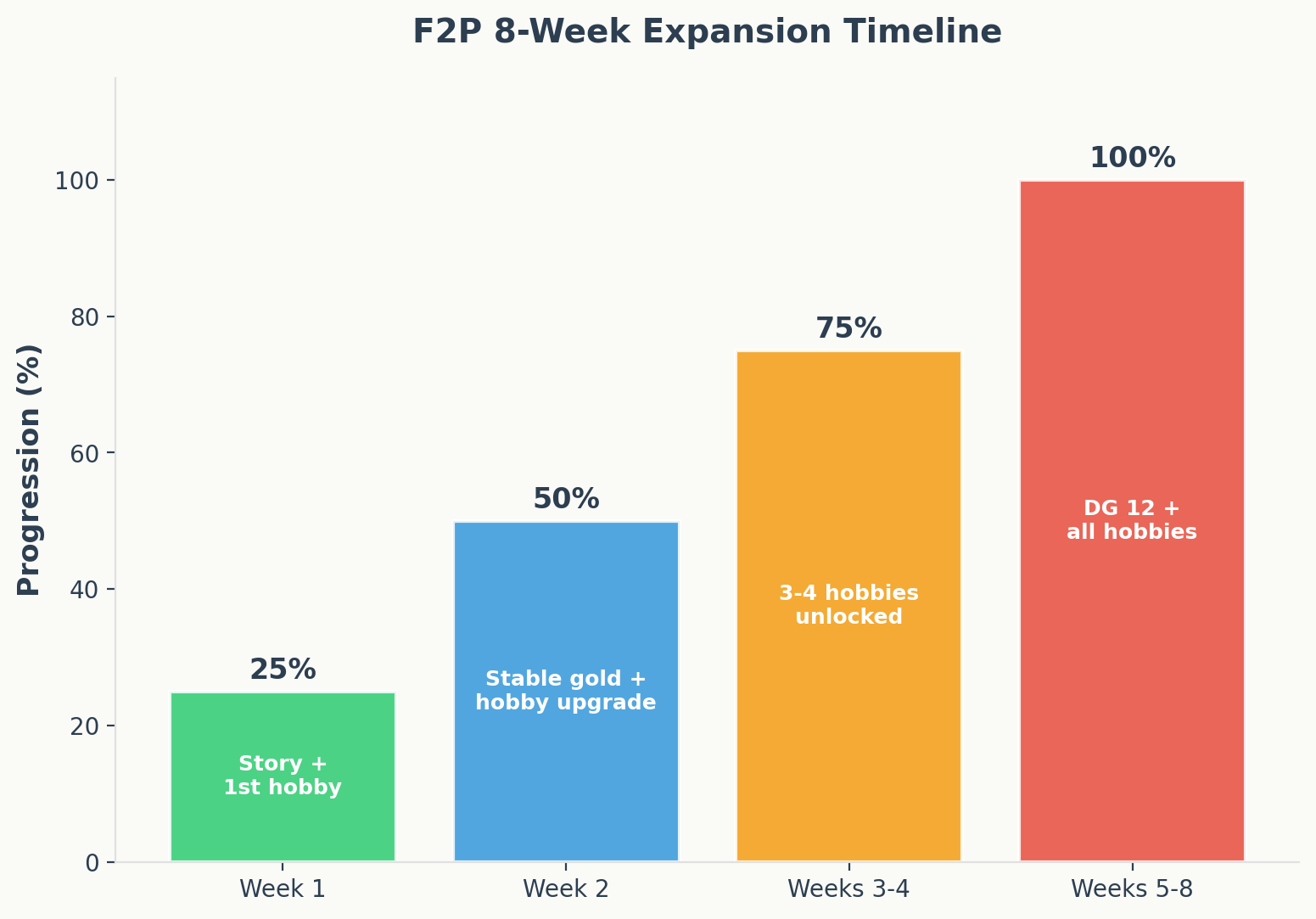
Here is a realistic timeline for a free-to-play player based on alt account tracking:
| Timeframe | Goals | Notes |
|---|---|---|
| Week 1 | Complete early main story + start gardening or fishing | Learn town layout, understand D.G. system |
| Week 2 | Establish a stable gold income source + first hobby upgrade | Expand plots via D.G. levels, upgrade the primary hobby |
| Weeks 3-4 | Unlock 3rd-4th hobbies (bug catching + cooking or bird watching) | D.G. 5+ tickets become available; start diversifying income |
| Weeks 5-8 | Raise D.G. level significantly toward 12 + unlock remaining hobbies | Cat and Dog Care require D.G. 12; aim for D.G. 50 long-term for Advanced Upgrade Tickets (levels 10-12) |
This timeline assumes roughly 30-60 minutes of play per day. Playing more means faster progress; playing less means each phase extends by a week or two. The important thing is consistency — even 20 minutes a day of commission completion and crop watering kept an alt account progressing steadily.
The Neighborhood Community System
Heartopia uses a shared-server neighborhood system where up to 12 players share the same world instance. This system has several social features that benefit F2P players:
– Visiting neighbors: Players can enter other players’ homes to see their layouts and decorating choices. No energy cost for visiting.
– Liking and sharing: Players can leave likes on homes they visit, and share food items with neighbors.
– Neighbor watering: When a friend visits a player’s garden and waters the crops, it can boost the star rating of those crops. Higher star-rated produce sells for more gold and produces higher-quality cooked dishes.
The community system is entirely free and provides tangible gameplay benefits. If placed in an active neighborhood, take advantage of the mutual watering — tomato quality jumped noticeably on an alt after a neighbor started helping with watering.
Key NPCs Every New Player Should Know
Beyond the hobby mentors, these NPCs matter for early progression:
| NPC | Role | Location |
|---|---|---|
| Grandpa Duke | Gives starter tools during the main story | Main story quest |
| Annie | Central main story character; unlocks bug catching | Main story quest |
| Vanya | Fishing mentor, blue hair | Garden Street |
| Bill | Sea fishing events, two boats | Fishing Village |
| Lang Hua | Bug catching mentor, straw hat | City area / Lang Hua Garden |
| Blanc | Gardening mentor, seed shop | Garden Street area |
| Massimo | Cooking mentor | Town area |
| Bailey J. | Bird watching mentor | Town center |
| Ms. Joan (Ms. Joan) | Cat Care and Dog Care mentor | Pet area |
If stuck on progression, talk to the relevant NPC — they often have dialogue that hints at the next step.
Frequently Asked Questions (FAQ)
Q: How to get more garden plots?
A: Through the Development Guild system. Completing daily commissions earns Contribution Medals, which raise the D.G. level. New plot slots unlock at specific D.G. level thresholds. Players start with 2 plot slots, and more open as they progress. Focus on commissions every single day — they are the fastest path to expansion.
Q: Which hobby should be unlocked first after the tutorial?
A: Gardening is free from the tutorial and provides the income foundation. After that, fishing with Vanya on Garden Street is recommended. Fish sell well even raw, and the fishing skill levels quickly by catching common freshwater species. Vanya is easy to find — she has bright blue hair and stands right on Garden Street.
Q: What are Hobby Expansion Tickets and how to get them?
A: Hobby Expansion Tickets are items that let players unlock new hobbies. They are rewarded through the Development Guild as certain D.G. levels are reached. They are not bought with gold or Wishing Stars. Just keep completing daily commissions and the D.G. level will climb, unlocking tickets naturally.
Q: What happens when a day of daily commissions is missed?
A: One day of Contribution Medal income is lost, which delays D.G. progress by that amount. Crops are more sensitive — missed watering pushes harvest back by the number of hours missed. The game does not kill crops from a single missed day, but consistent delays add up. Setting a phone reminder for the watering schedule helps during the first two weeks.
Q: How does the Home Rating weekly evaluation work?
A: Every week, the game evaluates a player’s home based on the furniture placed, room completeness, and decoration score. Furniture pieces and Wishing Stars are earned based on the rating. Submission must happen before the Saturday deadline each week — missing it once on a main account lost an entire week’s worth of Wishing Stars.
Q: What is the maximum hobby level?
A: All hobbies cap at level 12. Levels 1 through 10 use standard upgrade materials. To push from level 10 to 12, a player needs Advanced Upgrade Tickets, which are rewarded when the Development Guild level reaches 50. Early on, just focus on steady leveling — the advanced tickets are a long-term goal.
Q: How does neighbor watering work?
A: When visiting a neighbor’s garden and watering their crops, a player can help boost the star rating of those crops. In return, when neighbors visit the player’s garden and water the plants, the crops gain star rating too. Higher star-rated crops produce higher-value cooked dishes. Up to 12 players share each neighborhood server.
Q: Can Heartopia be played completely free-to-play?
A: Yes. Over 340 hours across two accounts have been played without spending anything. Purchases provide convenience only — faster timers, cosmetic items, quality-of-life shortcuts. There are zero pay-to-win stat advantages. Every piece of content, every hobby, and every level is accessible to F2P players. Wishing Stars are earnable through gameplay, primarily from the weekly Home Rating evaluation.
Related Guides
- Heartopia Achievements Guide: All 50 Badges & Hidden Milestones (2026)
- Heartopia Vehicles Guide: All 20 Cars, Costs & Speed Tiers (2026)
- Heartopia Free-to-Play Guide: Best Strategy for Zero Spending Players
About the Author
Mira Chen is a dedicated Heartopia player with over 340 hours of gameplay experience, actively maintaining two accounts — a main account with all hobbies maxed out and a free-to-play alt account played from a zero-spending beginner’s perspective. Every guide is based on firsthand testing and data. All content is written from a free-to-play perspective, objectively noting that purchases provide convenience only with no pay-to-win stat advantages. No cloud-gaming speculation, no content farming.
Mira focuses on Heartopia beginner guides, resource planning, and hobby-specific deep dives, publishing at least three tested guides per week. If a reader runs into any issues in-game, dropping a comment below helps — Mira reads and responds to as many as possible.
Join the Heartopia Community on Discord
Want the latest redemption codes, event announcements, and guide updates as soon as they drop? Join our Heartopia player community on Discord:
Join the Heartopia Discord Server
The server updates daily with beginner tips, event announcements, and strategy discussions across all hobbies. Whether a player is just starting out or a completionist with everything maxed, there is a spot for everyone. Drop in and join!