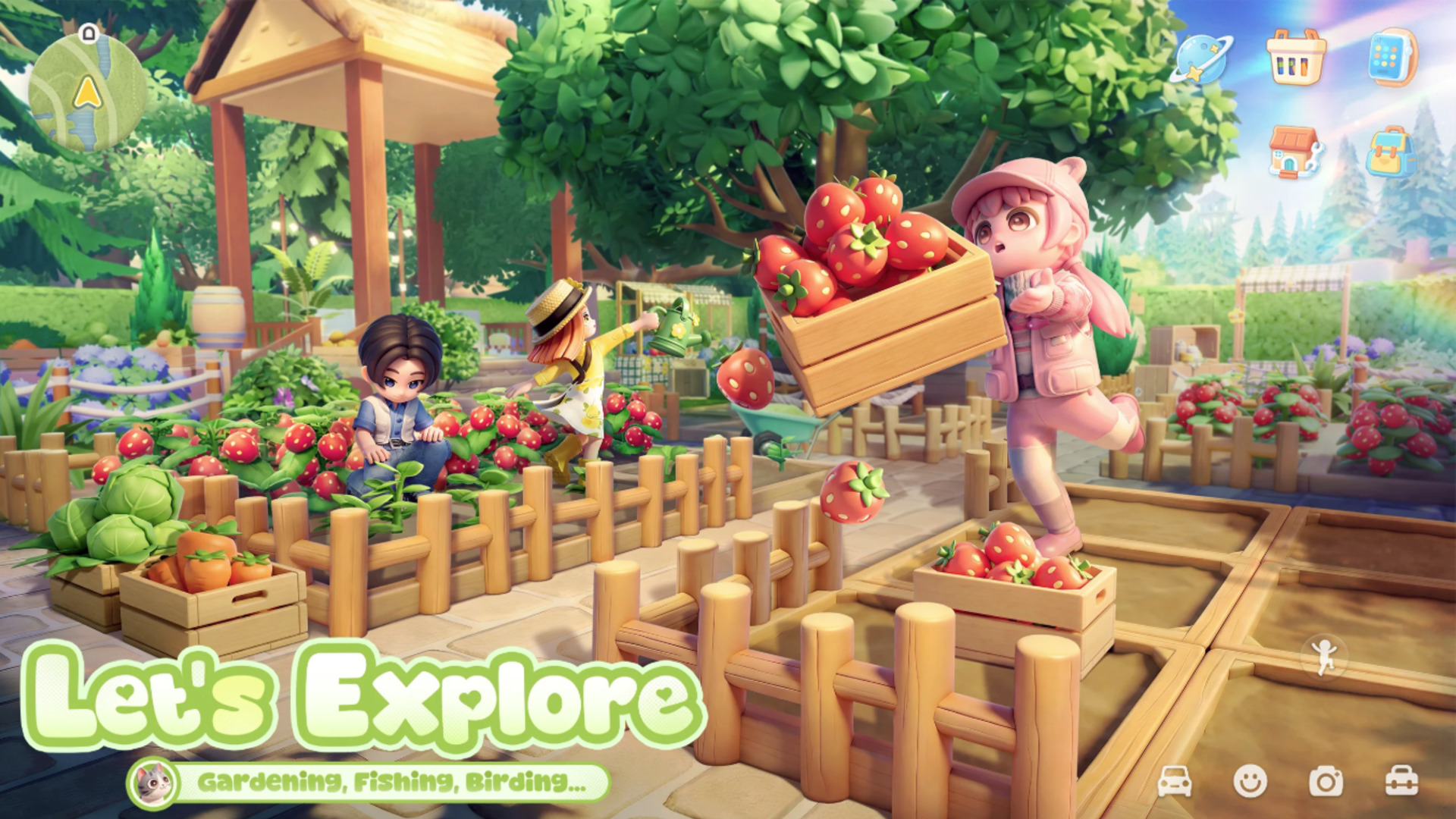
Cooking is one of the most rewarding hobbies in Heartopia, turning cheap raw ingredients into dishes that sell for three to four times their combined cost. With dozens of recipes spanning jams, soups, pies, salads, main courses, and desserts, mastering the cooking system is essential for converting farm produce into serious Gold. Beyond raw income, cooked meals restore energy for longer play sessions, progress the Cooking collection set, and open some of the highest-value gift options in the game.
This guide covers how to unlock cooking, every recipe category, unlock levels, ingredient sources, star quality pricing, and the highest-profit dishes, then ties it all together with a daily routine players can follow from day one.
How to Unlock Cooking
Cooking unlocks through the Developer’s Guild system. Players must reach D.G. Level 5 and obtain a Hobby Expansion Ticket, then speak to Massimo, who stands outside his café/restaurant in the Town Center. Massimo starts the hobby and introduces the cooking station.
- D.G. Level 5: Obtain a Hobby Expansion Ticket and speak to Massimo outside his café
- Cooking station: A public cooking station sits inside Massimo’s Restaurant in Town Center; players can also craft a personal station at home after reaching Cooking Level 5
- Recipe sources: New recipes unlock from cooking level progression, quests, recipe scrolls, Massimo friendship, and Doris the head chef
Reaching D.G. Level 5 is rarely a long detour. The early Developer Guild tiers are front-loaded with simple construction and gathering quests, so most players arrive at Level 5 within the first few in-game weeks. Players who want cooking as their earliest money engine should avoid spending D.G. rewards on cosmetic options and focus on the ticket and station unlocks instead.
A personal cooking station is worth crafting as early as possible. The Town Center station is shared, and during peak playtimes it can be occupied. A home station removes the queue entirely and lets players cook before the town store opens. Building one also counts toward the weekly Home Assessment score, giving a small but useful secondary benefit.
For the full hobby unlock sequence and best D.G. order, see the Hobby Unlock Guide. Players who prioritize cooking early should follow the recommended D.G. leveling path.
Recipe Categories
Heartopia divides its recipes across several categories, from quick jams to complex main courses. The largest groups are desserts, jams, drinks, soups, and main courses, giving players flexibility to cook whatever ingredients they have on hand.
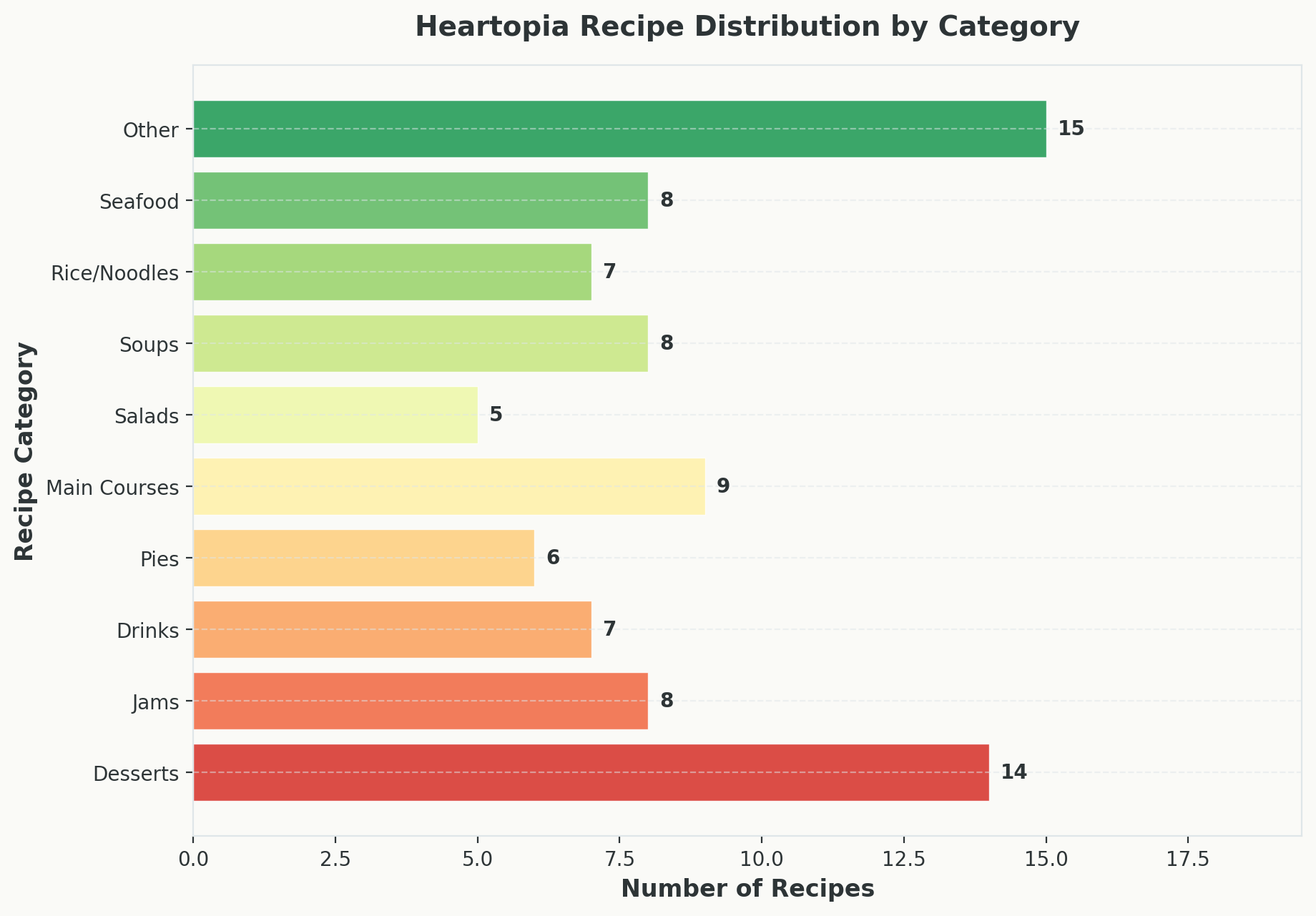
Jams are the most accessible category for new players because they accept any fruit, while desserts and main courses require more diverse ingredients. This category spread means cooking progress scales smoothly as players expand their crop variety across seasons.
A useful practical distinction is between single-ingredient recipes and multi-step recipes. Single-ingredient jams and drinks are ideal for easing into the hobby because they fail rarely and use whatever the player already harvested. Multi-step dishes such as pies and main courses require prepared components — flour from wheat, butter from milk, or seasoning from herbs — and reward players who invest in crop processing early.
The category mix also shapes the Cooking collection set. Because Cooking Recipes lead the Collection database at 98 entries, players who cook across all categories are effectively completing the largest collection category in the game at the same time. This overlap is a strong reason to keep a running list of which dishes are still unlogged in the Collection menu rather than repeatedly cooking only the most profitable few.
Recipes by Unlock Level
Recipes unlock progressively as players raise their Cooking hobby level. Early levels introduce basic jams, soups, and salads, while the highest-value dishes arrive at Levels 8-12.
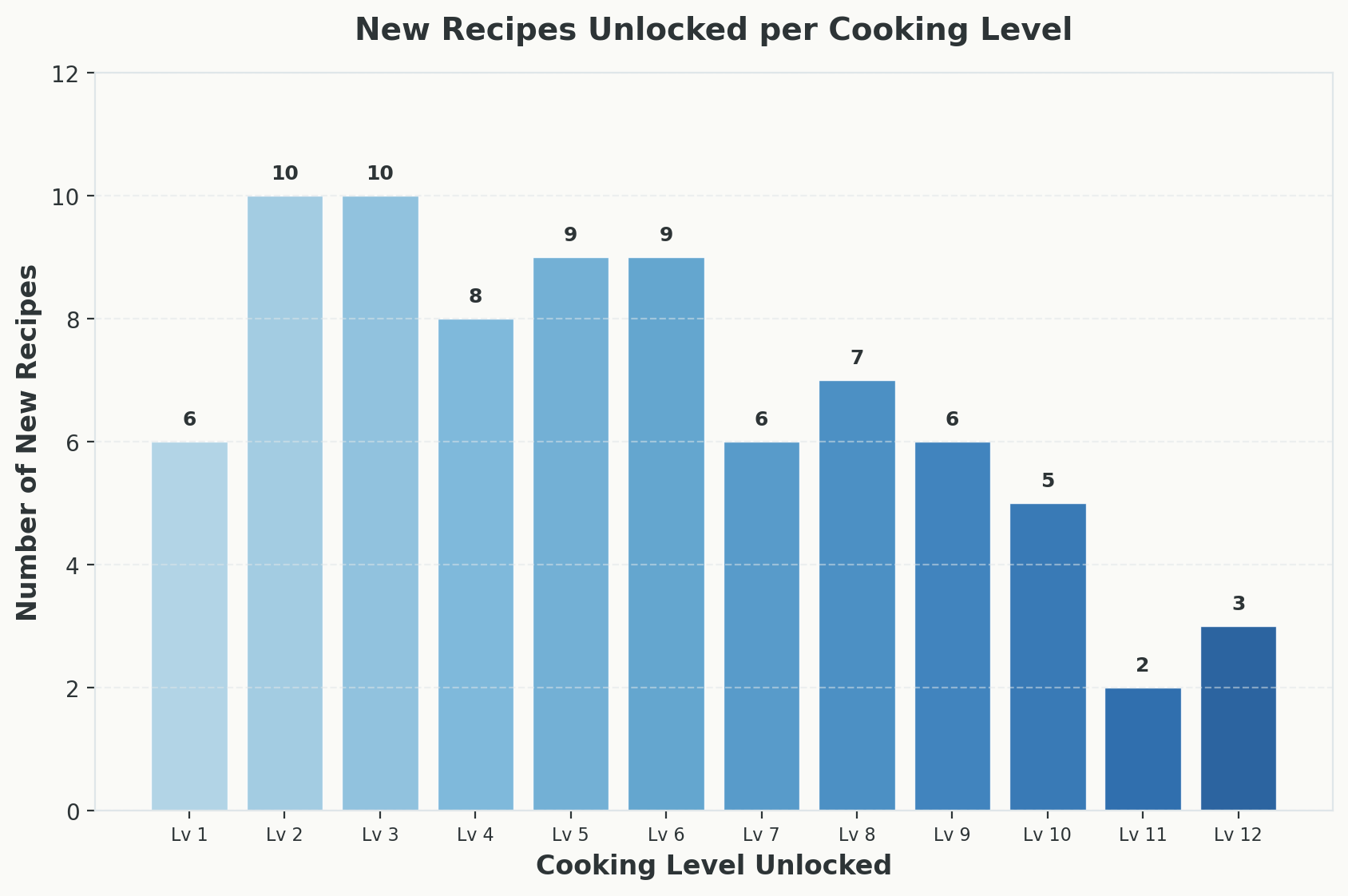
The level curve is front-loaded: most recipes unlock in the Level 2-6 range, so early cooking progress delivers recipes quickly. Levels 10-12 offer fewer but far more valuable recipes, including premium seafood and dessert dishes.
Because the curve front-loads unlocks, most of the profitable daily rotation is available by Cooking Level 6. Reaching that threshold early means players do not need to grind late-game levels just to unlock a working money loop — they simply need a reliable set of the best Low-to-Mid level dishes and the ingredients to power them.
For players chasing the Cooking collection, it is worth deliberately leveling past the point where only favorites are cooked. Several rare dishes only appear as unlock scrolls or premium purchases, so the collection completion percentage depends on accessory recipes just as much as the core rotation. Checking the Collection menu’s Cooking category is the simplest way to see which recipes are still missing before committing to a cooking session.
Ingredient Sources
Nearly every recipe ingredient comes from another Heartopia hobby, creating a connected economy. Understanding where each ingredient comes from helps players plan what to gather before cooking:
| Ingredient | Source | Example Dish |
|---|---|---|
| Fruit & vegetables | Gardening crops, seasonal harvest | Strawberry Jam, Garden Salad |
| Fish & seafood | Fishing hobby | Fish Chowder, Sushi |
| Mushrooms | Foraging / gathering | Mushroom Stew, Mushroom Pie |
| Milk, eggs, cheese | Animal products / shop | Cheese Cake, Pancakes |
| Wheat & flour | Crop processing | Apple Pie, Bread |
| Herbs & spices | Foraging | Herbal Tea, Seasoning |
Because ingredients span multiple hobbies, players who level fishing and gardening together cook far more efficiently than those focused on a single hobby.
Batch gathering works far better than reactive gathering. Instead of running to a source only when a specific dish is needed, players should set small recurring targets: keep a dozen mushrooms in storage, maintain a stack of spring fruit for jam, and process wheat into flour the day it is harvested. Building these reserves means the cooking station is always usable, and it prevents the common early-game loop of eating all perishable ingredients as snacks before they reach a recipe.
Seafood and animal products deserve special attention because they combine cooking with two other progression systems. Fish caught for profitable fishing also serves as sushi and chowder ingredients, while milk and eggs from barn animals feed both dessert recipes and the barn-animal collection sets. Players who plan these overlaps get three value streams from a single gathering trip: the raw profit, the recipe income, and the collection progress.
For a focused profit-tips guide, see Cooking: Best Profit Food.
Star Quality Pricing
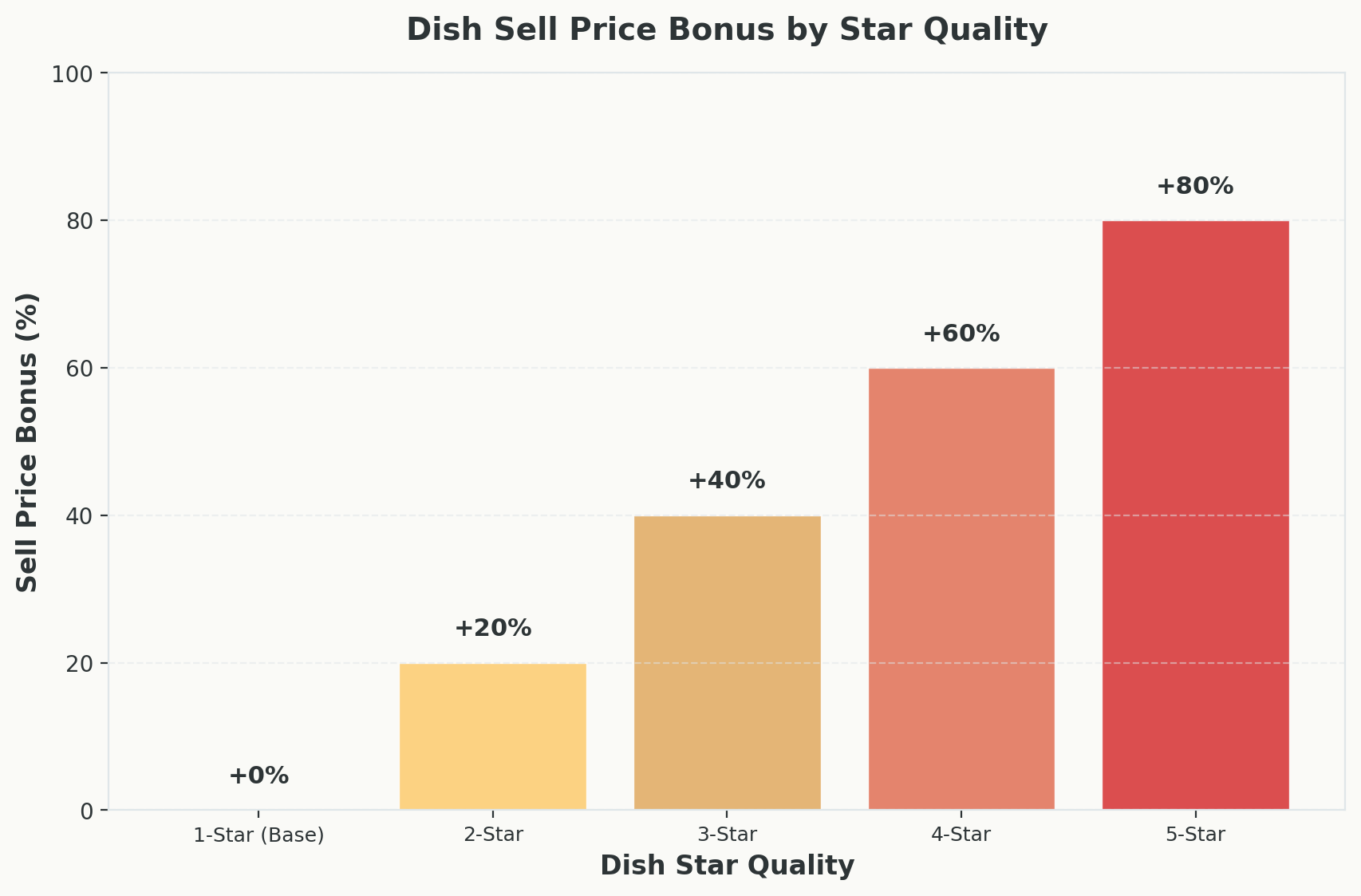
A dish’s star quality is determined by ingredient timing and quality, and it directly controls the sell price. Higher-star dishes sell for significantly more and restore more energy, making quality cooking more profitable than rushing.
| Star Quality | Sell Price Bonus |
|---|---|
| 1-Star (Base) | 0% |
| 2-Star | +20% |
| 3-Star | +40% |
| 4-Star | +60% |
| 5-Star | +80% |
Data source: heartopia.gg recipe database. D.G. members also receive an additional 1.1x bonus on dish sell prices, compounding with star quality for maximum returns.
Because the star bonus applies as a percentage multiplier, high-value dishes benefit the most from quality ingredients. A +80% bonus on Mushroom Stew adds hundreds of extra Gold per dish, whereas the same bonus on a cheap House Salad adds only a few dozen. This means players should reserve their highest-quality ingredient stock for the most profitable recipes rather than spending it evenly across the menu.
Energy restoration scales with star quality too. A 5-star dish restores noticeably more energy than its base version, and since energy gate the number of actions a player can take in a day, cooking a few high-star meals can effectively add work hours to a play session. For active days, quality cooking is as much a stamina tool as it is an income tool.
Most Profitable Recipes
Some recipes generate far more profit than others once ingredient costs are accounted for. The top dishes convert cheap foraged and farmed ingredients into high-value meals with excellent margins.
| Recipe | Level | Ingredient Cost | Sell Price | Profit |
|---|---|---|---|---|
| Mushroom Stew | 3 | ~150g | 650g | +500g |
| Button Mushroom Pie | 3 | ~200g | 650g | +450g |
| Salmon Sushi | 4 | ~250g | 600g | +350g |
| Fish N Chips | 1 | ~80g | 230g | +150g |
| House Salad | 1 | ~30g | 120g | +90g |
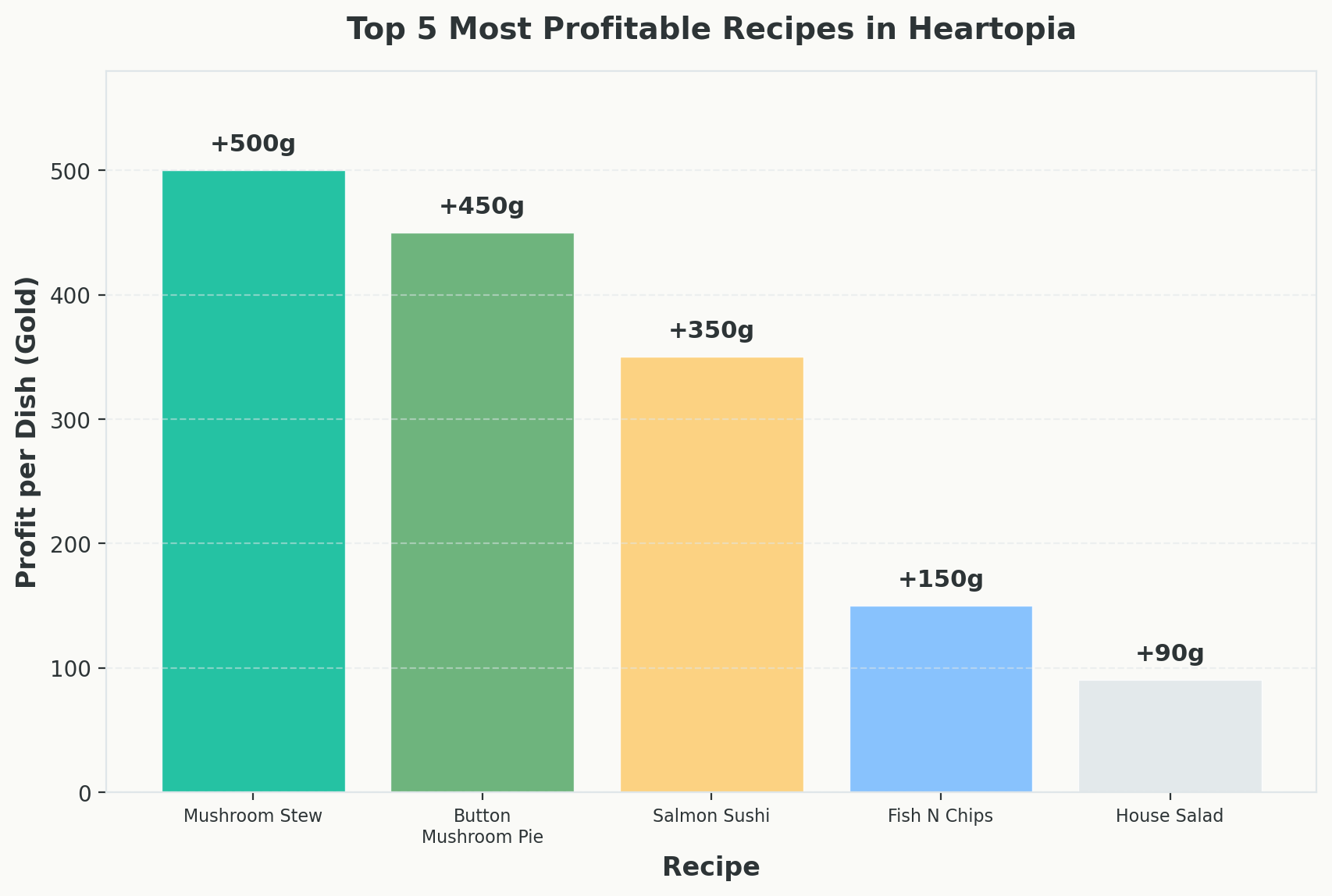
Mushroom Stew and Button Mushroom Pie lead the profit rankings, delivering over 450 Gold profit per dish from foraged mushrooms. Seafood dishes like Salmon Sushi also carry strong margins, rewarding players who combine profitable fishing with cooking.
Profit per dish is only half the picture — profit per ingredient matters just as much. Mushroom Stew leads because mushrooms are free to forage, so its entire ~150g ingredient cost is essentially recycled time rather than spent Gold. Dishes that require store-bought components (milk, butter, or spices) have thinner true margins even if their sell price looks high, because the player pays Gold up front for the components.
A practical rule is to keep the top two mushroom dishes in the daily rotation and spend the gathered mushroom surplus there, then use the fishing and gardening catches for medium-tier seafood and fruit dishes. Players who over-invest in store-bought premium dishes early on often notice their bank balance grows slower than expected, purely because component costs eat into the headline sell price.
Premium & Specialty Recipes
Beyond standard recipes, Heartopia offers premium dishes that require rare ingredients or high Wishing Star costs. The most valuable are the eight Doris Specials, which use rare ingredients and are the highest-value dishes in the game.
Notable premium recipes include:
| Recipe | Unlock Source | Notes |
|---|---|---|
| Original Roll Cake | 50 Wishing Stars | Doris Special, collectible |
| Meat Sauce Pasta | 800 Wishing Stars | High-value pasta dish |
| Apple Pie | 1,600 Wishing Stars | Classic premium dessert |
| Afternoon Tea | 3,200 Wishing Stars | Special celebration dish |
| Candlelight Dinner | 6,400 Wishing Stars | Premium date food, uses Steak & Wine |
Roll Cake variants (Red, Orange, Blue, etc.) come from Doris the Merchant and require dye ingredients, making them collectible items for completionists. For a full collection strategy, these premium dishes are worth cooking once each even if they are not the most efficient profit sinks.
Premium dishes should be treated as late-game tools rather than daily staples. Their high Wishing Star cost means early players should not chase them at the expense of the mushroom rotation — a single Candlelight Dinner unlock could fund weeks of standard cooking. Instead, premium dishes earn their keep in two specific roles: filling the Cooking collection entries, and serving as top-end gifts for the NPCs whose best-loved items are cooked meals.
Cooking for Gifting vs. Selling
Cooked food is not only a source of income — it is also one of the broadest gift categories in the game. Several villagers count cooked dishes among their best-loved gifts, and while the exact preferences vary per character, meals generally outperform raw ingredients for relationship gain.
Players who are actively raising NPC friendship should set aside a small gift reserve from each cooking batch. Keeping two or three of the highest-value dishes in storage — Candlelight Dinner and the Roll Cake variants are prime examples — ensures there is always a strong gift on hand without raiding the sell stock.
The balance between selling and gifting changes over time. Early on, selling everything maximizes short-term Gold for tools and station upgrades. Once the station and bank are comfortable, shifting a portion of output toward premium gifts unlocks NPC-exclusive rewards that are themselves worth real money value. A player who cooks with both goals in mind ends up ahead of one who optimizes purely for sell price.
Best Cooking Strategy
To maximize cooking profit, players should follow this strategy:
- Level to Cooking 3 first to unlock Mushroom Stew and Button Mushroom Pie, the two highest-profit recipes
- Gather mushrooms from foraging to cut ingredient costs on the top two dishes
- Use high-quality ingredients to reach higher star ratings for the +20% to +80% price bonus
- Combine with fishing so Salmon Sushi and Fish Chowder are always cookable
- Cook in daily batches rather than mass production to preserve ingredient quality
- Save premium dishes like Candlelight Dinner for NPC gifting rather than selling
Cooked food generally sells for three to four times the raw ingredient cost, so cooking is effectively a profit multiplier on everything the player grows or catches. It is the highest-value way to convert farm produce into Gold, and it also restores energy for longer play sessions.
A sample early-game daily loop looks like this: forage mushrooms in the morning, gather fruit from the season’s crops, cook the two top mushroom dishes in a single evening session, sell the surplus, and set aside one meal for gifting. Repeating this loop for a few in-game weeks builds a steady Gold stream while also filling the Cooking collection. Players who add fishing to the rotation are then cooking three profit tiers at once — the mushroom base, the seafood mid-tier, and the occasional premium gift.
Frequently Asked Questions
How do players unlock cooking in Heartopia?
Cooking unlocks at D.G. Level 5 after obtaining a Hobby Expansion Ticket and speaking to Massimo outside his café in Town Center. He introduces the cooking station and starts the hobby.
How many recipes are in Heartopia?
Source databases list between 61 and 98 recipes depending on version and translation. The most complete reference is the heartopia.app wiki listing 87 dishes across jams, soups, pies, salads, main courses, desserts, and drinks.
What is the most profitable dish in Heartopia?
Mushroom Stew is the most profitable recipe studied, delivering roughly +500 Gold profit per dish from about 150 Gold in ingredients. Button Mushroom Pie trails closely at +450 Gold profit.
Does dish star quality affect sell price?
Yes. A 2-star dish sells for +20% more, rising to +80% at 5-star. Ingredient timing and quality determine the dish’s star rating, so careful cooking earns significantly more than rushed batches.
Should players sell premium dishes?
Generally no. Premium dishes are better kept as top-end NPC gifts or used to fill Cooking collection entries, since their high Wishing Star cost makes them inefficient as daily profit sinks compared to mushroom dishes.