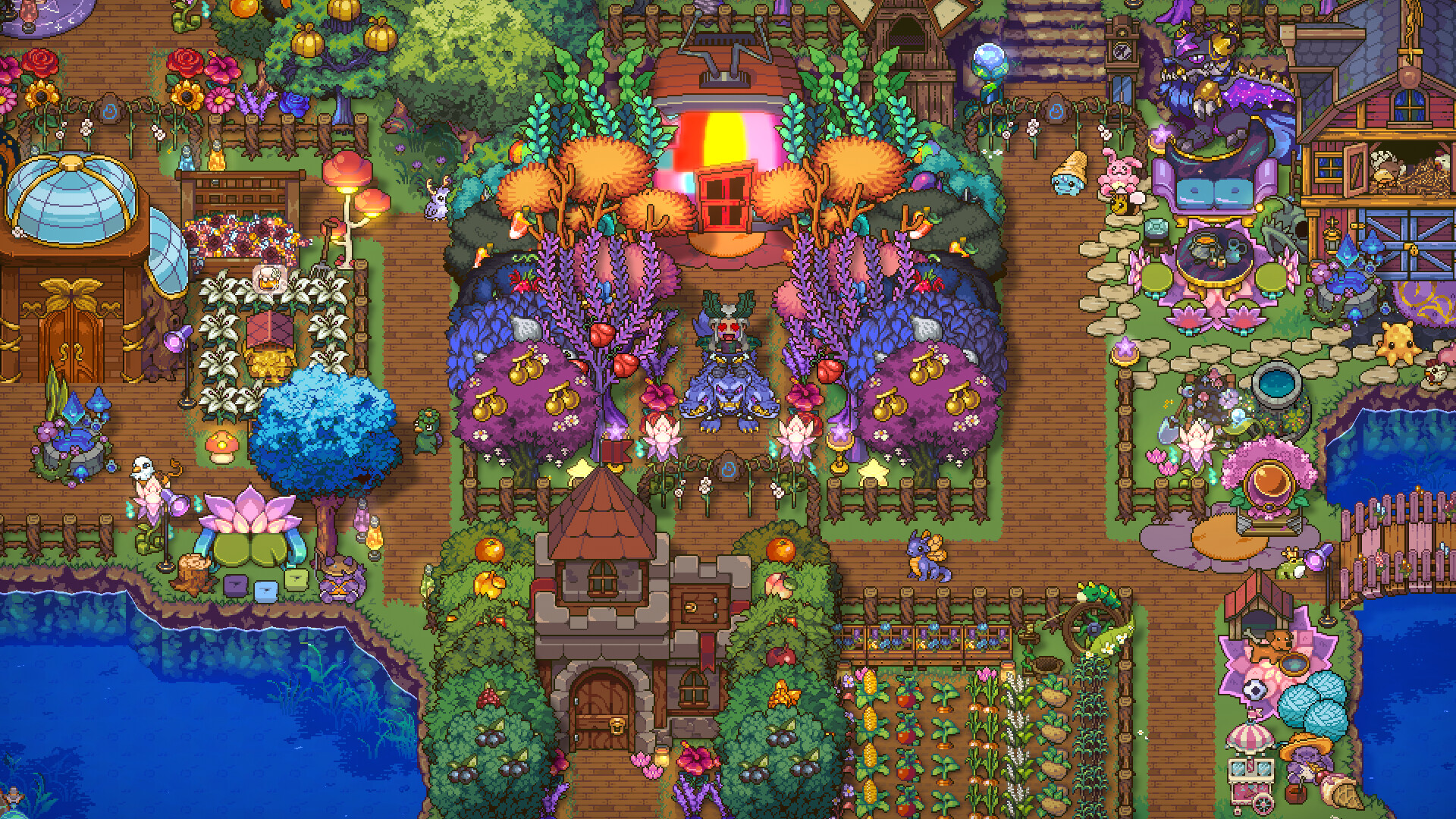
Designing an efficient farm in Sun Haven requires careful planning of building placement, crop field sizing, and pathing systems. With three distinct farm zones, multiple building types, and tiered sprinkler coverage, the layout decisions made in the first week can impact gold income for dozens of hours. This guide breaks down every farm building’s cost, dimensions, and placement rules, along with optimal layout strategies for early, mid, and late game progression.
Understanding the Three Farm Zones
Sun Haven features three separate farm zones, each unlocked through main story progression. Every zone offers unique resources, terrain features, and building opportunities that influence layout decisions.
Sun Haven Farm (Starting Zone)
The default farm provides the most flexible layout space in the game. Key terrain features include two ponds for fishing, two elevated sections suitable for buildings, and a beach area. Five exits connect the farm to Sun Haven town, the Western Forest toward Nel’Vari, and the beach pier. Unlike other zones, players can place their house anywhere on this farm. The terrain is covered with trees that drop Logs, Stones, Silk, and Mushrooms when chopped, providing early crafting materials. A Crafting Table is provided near the entrance.
Nel’Vari Farm
Unlocked upon reaching Nel’Vari village through the main quest, this farm comes with a pre-built house at the top-left corner, eliminating the 25,000g house purchase cost. Four small ponds sit at the north, south, east, and west edges. The zone contains elven trees, elven hardwood trees, and elven stones unique to this region. A pre-existing chest, crafting table, and elven crafting table are provided. For players following the skill tree progression guide, the Nel’Vari farm becomes essential for elven material farming.
Withergate Rooftop Farm
The most compact farm zone, located atop the Withergate Apartment. The terrain is covered in Dead Logs, Spooky Silk, and Mushrooms. A Monster Crafting Table is provided, and fishing is available in the water tower. No house purchase is needed. This farm excels as a dedicated storage or crafting zone rather than a primary crop farm.
Building Placement Rules & Mechanics
Sun Haven uses a tile-based grid system for all building placement. Understanding the core mechanics prevents costly relocations later.
Core Placement Rules
Buildings are placed by left-clicking the item from inventory, then left-clicking on an available area of grass. Buildings must be placed on grass tiles and cannot be placed on floor tiles, paths, or water. The House can be placed freely on the Sun Haven Farm, but Nel’Vari and Withergate farms have pre-set house locations.
Moving Buildings with Demolition Kits
Relocating placed buildings requires a Demolition Kit, purchased from Town Hall for 2,500g. Before demolishing, all animals and items must be removed from the building interior. Demolishing drops the building as an inventory item for re-placement. The Greenhouse is an exception: using a pickaxe on it drops it as an item, and relocating does not destroy interior contents, making it safe to move even with crops growing inside.
All Farm Buildings: Costs, Dimensions & Limits
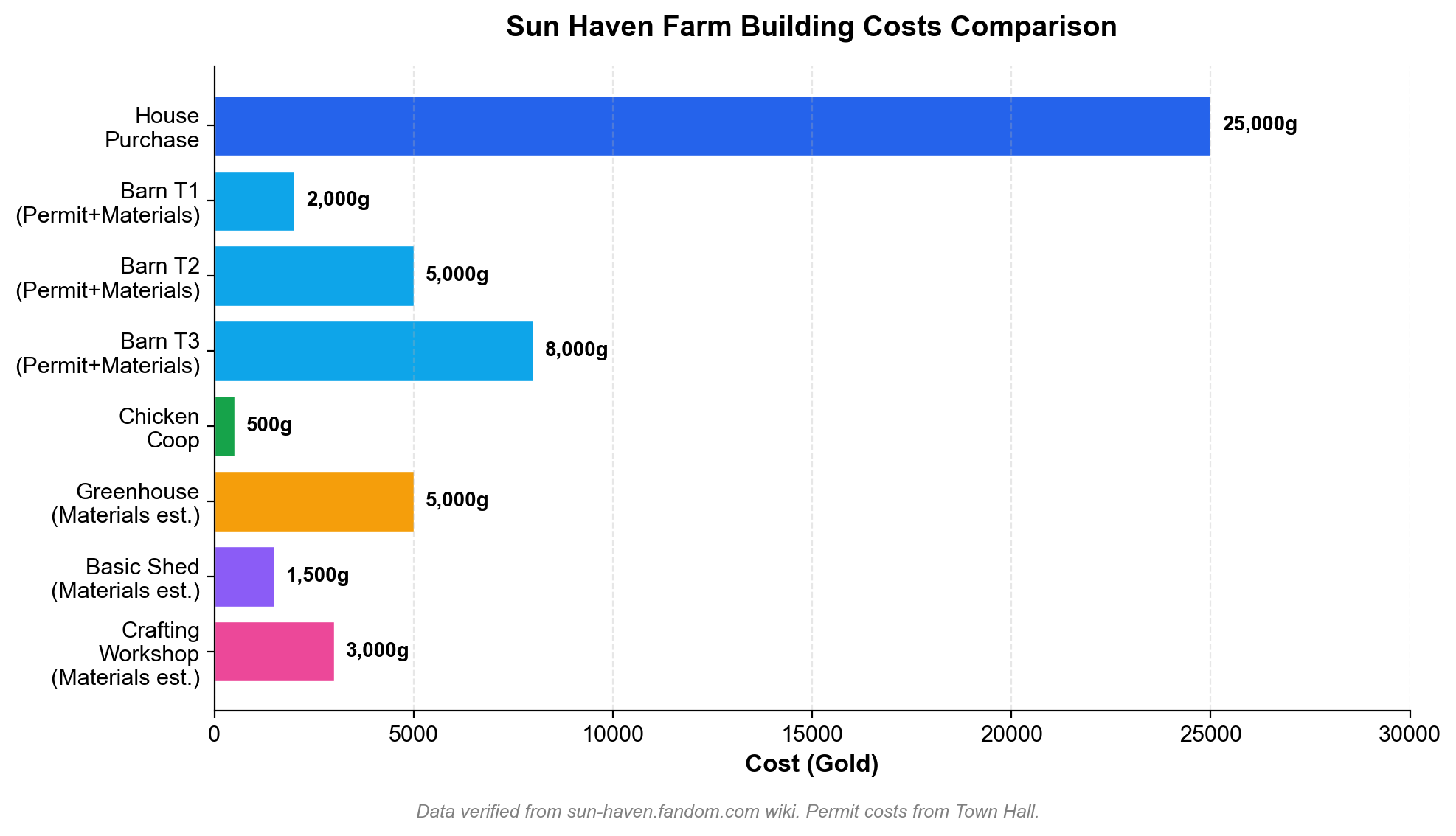
Each building type serves a specific purpose and has strict quantity limits per farm. The table below summarizes every buildable structure with verified data from the community wiki.
| Building | Max Quantity | Permit/Material Cost | Exterior (W x H tiles) | Interior Space |
|---|---|---|---|---|
| House | 1 per farm | 25,000g (Town Hall) | 10 x 5 | Varies by tier |
| Barn (Tier 1) | 4 per farm region | Barn Permit (2,000g) + Wood Plank x20 + Stone x50 | 6 x 4 | 10 feeding stations, 8 animals |
| Barn (Tier 2) | Upgrade | Tier 2 Permit (5,000g) + Wood Plank x50 + Hardwood Plank x50 | 6 x 4 | 16 animals |
| Barn (Tier 3) | Upgrade | Tier 3 Permit (8,000g) + Wood Plank x50 + Hardwood Plank x50 | 6 x 4 | 24 animals |
| Chicken Coop | Multiple | Stone x50 + Wood Plank x25 + Egg x3 | 7 x 4 | 4 feeding stations |
| Greenhouse | 4 (1 per season) | Wood Beam x25 + Compost x25 + Season Teleportation Gem x1 | 5 x 3 | 411 farmable tiles |
| Basic Shed | 12 (all farms) | Wood Plank x50 + Log x40 | 6 x 3 | Barn-sized interior |
| Crafting Workshop | 1 per region | Heavystone x100 + Wood Beam x25 + Hardwood Plank x15 | 6 x 3 | 26 x 13 (338 tiles) |
Players following the house upgrade guide should note that Tier 2 House Permits cost 10,000g and Tier 3 permits cost 30,000g, both purchased at Town Hall. Each upgrade significantly increases interior space for furniture and storage placement.
Sprinkler Coverage & Crop Field Layout
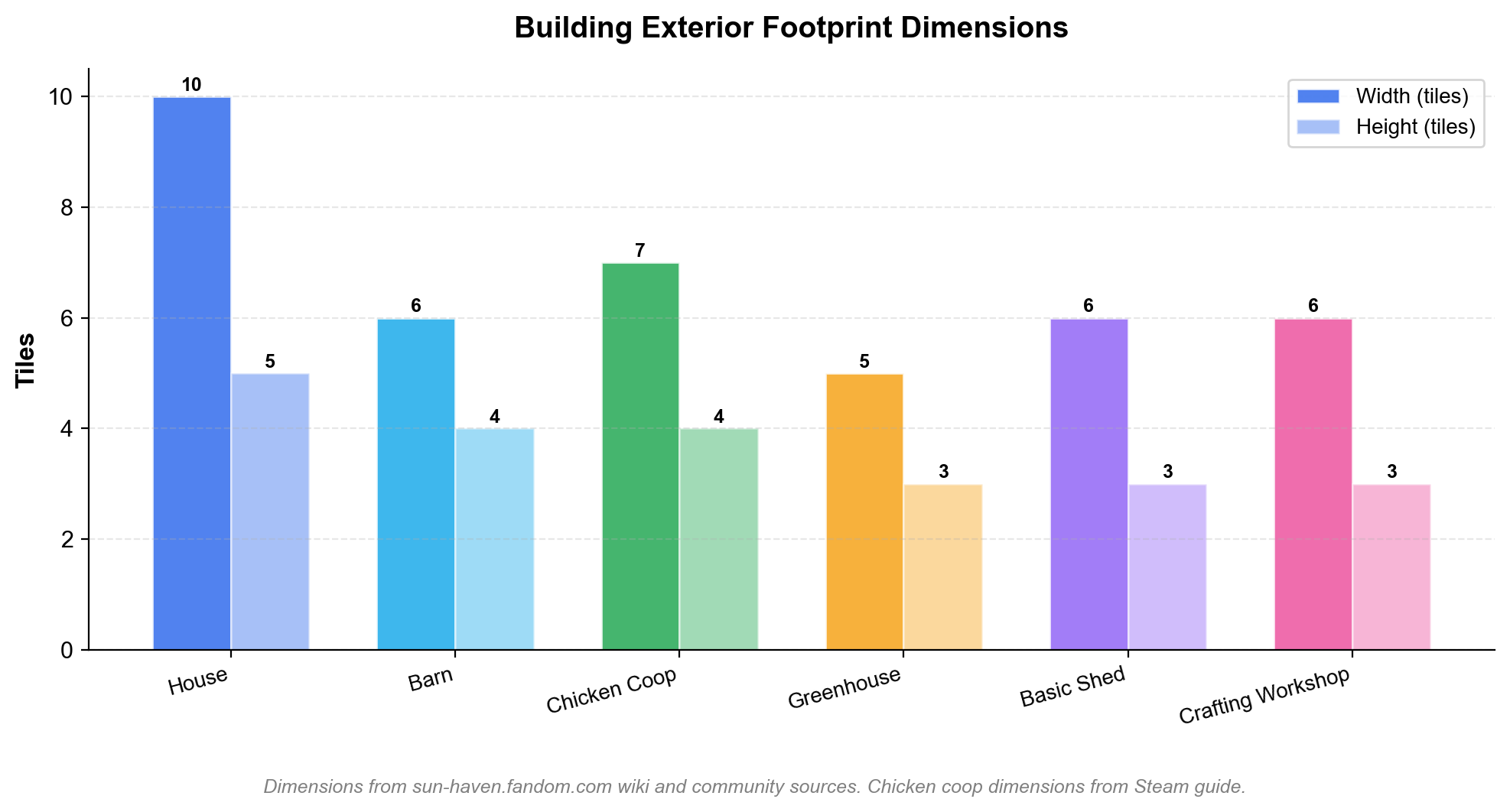
Sprinklers are the most important automation tool for farm layout. Three tiers exist, each watering a progressively larger area. Proper sprinkler placement determines the optimal crop field size and shape.
| Sprinkler | Coverage Area | Tiles Watered (excl. center) | Unlock Requirement |
|---|---|---|---|
| Sprinkler I | 3 x 3 square | 8 tiles | Farming Level 2 |
| Sprinkler II | 5 x 5 square | 24 tiles | Farming Level 6 |
| Sprinkler III | 9 x 9 square | 80 tiles | Farming Level 9 |
Farming spells complement sprinkler systems. The Earthquake spell (Farming skill Tier V) instantly tills a 5×5 square of 25 tiles for 50 mana, while the Rain Cloud spell (Tier VII) waters crops in a 5-tile wide strip traveling 10 tiles for 60 mana. Neither spell has a cooldown. Players optimizing their farming profit strategy should rush Farming Level 9 to unlock Sprinkler III, which waters 80 tiles from a single placement.
Greenhouse Farming
Each Greenhouse contains 411 farmable tiles inside, making it the most space-efficient growing area in the game. Only one greenhouse per season type is allowed (Spring, Summer, Fall, Winter), with a maximum of 4 total. No scarecrows or totems are needed inside greenhouses, and weather effects like rain apply indoors, auto-watering crops. For seasonal crop strategies, consult the spring crops guide and summer crops guide.
Optimal Farm Layout Strategies
Farm layout should evolve through three distinct phases as resources and unlocks progress. Each phase prioritizes different buildings and crop field sizes.
Early Game (Days 1-7)
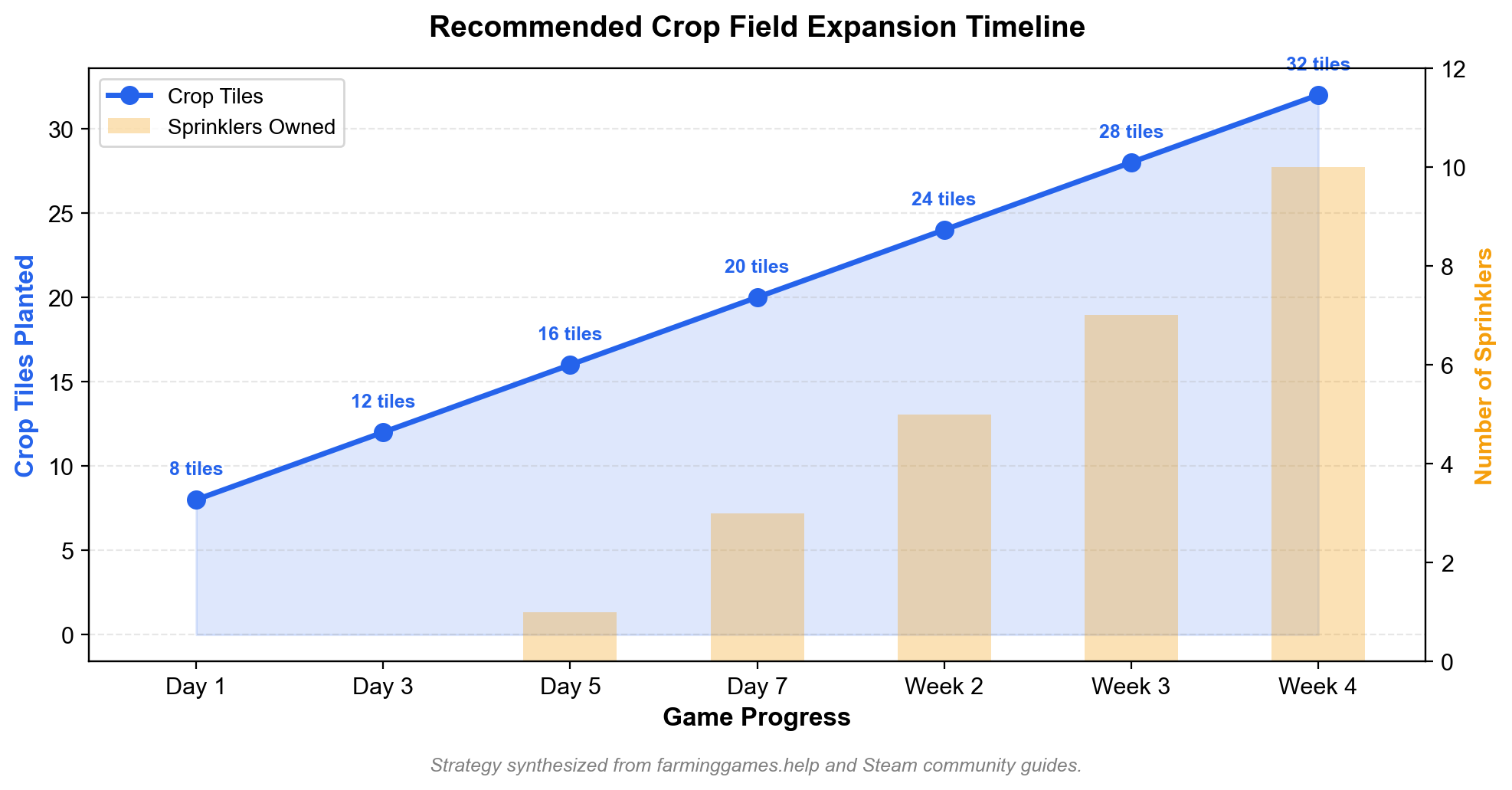
Start with 8 crop tiles (4 wheat + 4 sunflower) near the farm entrance for quick access. Expand to 12 tiles by Day 3 by reinvesting wheat harvest profits. By Day 5, add tomatoes as a regrowing crop to reduce replanting labor. Reach 20+ crop tiles by Day 7 with at least 3 Tier I sprinklers placed. Prioritize building a Chicken Coop (requires only Stone x50, Wood Plank x25, and Egg x3) for passive egg income. The first Barn Permit (2,000g) should be purchased once crop income stabilizes.
Mid Game (Weeks 2-4)
Expand to 24-32 crop tiles with full Sprinkler II coverage. Build the Crafting Workshop for access to 338 interior tiles of workstation space. Construct the first Greenhouse for out-of-season crop growing. Add a Basic Shed for dedicated storage, freeing house interior space. Players following the barn animals guide should upgrade barns to Tier 2 (16 animal capacity) during this phase.
Late Game (Month 2+)
Unlock all three farm zones through story progression. Dedicate the Sun Haven farm to crop production with Sprinkler III coverage (80 tiles per unit). Convert Nel’Vari farm to elven material harvesting and animal husbandry with Elven Barns (the elven variant of standard Barns, available from Nel’Vari vendors). Use the Withergate Rooftop Farm as a storage hub with multiple Sheds. Build all 4 Greenhouses for year-round seasonal crop growing. The mining guide provides material sourcing strategies for late-game construction projects.
Pathing & Decoration System
Floor tiles serve both functional and aesthetic purposes on the farm. The Tile Maker, crafted at a Crafting Table with Wood Plank x15 and Stone x20 (45-minute craft time), produces tiles in batches of 10. Eight tile types are available, ranging from Brick Floor Tiles (Stone x35 per batch) to Oak Plank Floor Tiles (Wood Plank x10 per batch).
Tile Functions Beyond Decoration
Floor tiles prevent trees from growing atop them when placed on the farm, making them essential for maintaining clear building zones. The Architect skill in the Exploration skill tree grants +10%, +15%, or +20% movement speed when traveling over placed tiles, depending on skill point investment. This movement bonus compounds with tool upgrade strategies to significantly reduce daily farm maintenance time.
Available Tile Types
| Tile Type | Ingredients (per 10 tiles) | Craft Time |
|---|---|---|
| Brick Floor Tile | Stone x35 | 1 hour |
| Oak Plank Floor Tile | Wood Plank x10 | 1 hour |
| Patterned Floor Tile | Stone x35 | 1 hour |
| Stone Floor Tile | Stone x35 | 1 hour |
| White Stone Floor Tile | Stone x35 | 1 hour |
| Wood Floor Tile | Wood Plank x10 | 1 hour |
| Wooden Plank Floor Tile | Wood Plank x10 | 1 hour |
| Workshop Floor Tile | Stone x35 | 1 hour |
Frequently Asked Questions
How many barns can be built per farm in Sun Haven?
Players can build up to 4 barns per farm region. Sun Haven barns are built on the Sun Haven farm, while Elven Barns are built on the Nel’Vari farm. Each barn can be upgraded to Tier 3, holding up to 24 animals.
Can buildings be moved after placement?
Yes, but a Demolition Kit (2,500g from Town Hall) is required to move the House, Barn, Chicken Coop, or Workshops. All animals and items must be removed before demolishing. Greenhouses are the exception and can be moved with a pickaxe without losing interior contents.
What is the maximum number of sheds allowed?
According to the Industrial Brick Shed Kit page (patch 1.3), the shed limit was increased to 12 across all farms. The original Basic Shed page listed a limit of 4, but the newer patch data reflects the current 12-shed maximum.
How many farmable tiles are inside a Greenhouse?
Each Greenhouse contains 411 farmable tiles. Players can build up to 4 Greenhouses total, one per season type, allowing year-round crop production regardless of the current season.
Which farm zone is best for new players?
The Sun Haven Farm is the recommended starting zone due to its spacious layout, flexible house placement, and five exits providing easy access to town and other regions. The two ponds and beach area also offer fishing opportunities for early income.
Do sprinklers work inside Greenhouses?
Sprinklers are not needed inside Greenhouses because weather effects like rain apply indoors, automatically watering all crops. This makes Greenhouses the most maintenance-free growing environment in the game.
Love cozy farming games?
Check out our complete Heartopia Guide — mobile cozy town simulation with home building, gardening, and cute neighbors!
🏡 Explore Heartopia →