Farming is the economic engine of Sun Haven, but new players who plant blindly lose a full season’s worth of gold. The game runs on a strict four-season cycle, and every crop has a growth timer measured against a fixed season window. Understanding that clock — exactly how many days each season gives, which crops fit that window, and when to stop planting — is the difference between a profitable first year and a wasted one.
- Each Season Runs for 28 Days
- Year-Round Crops Are the Anchor of Every Plan
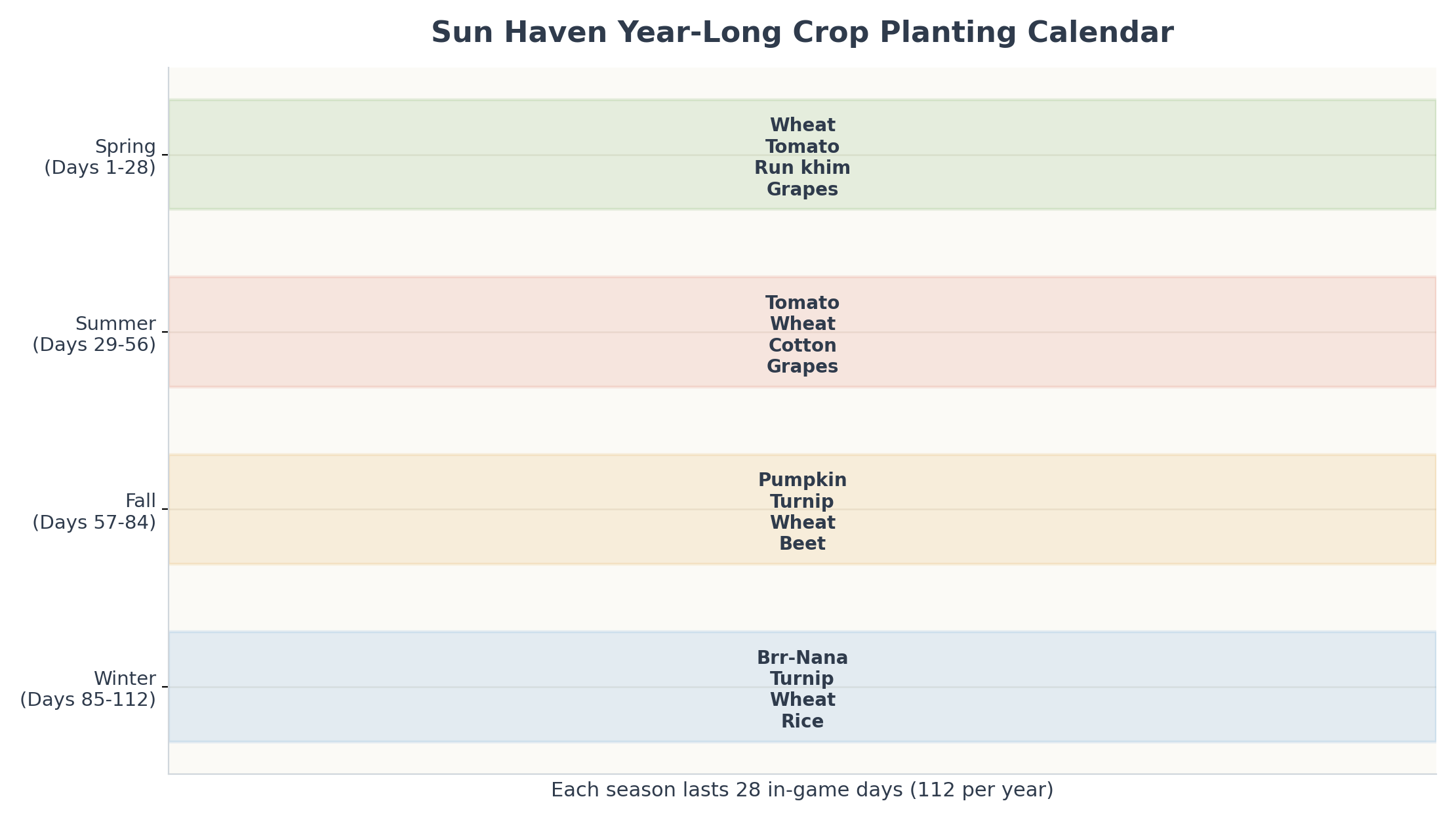
- Spring Planting Window: Days 1–28
- Summer: Beat the Fire Effect
- Fall: Pumpkin and Turnip Timing
- Winter: Brr-Nana and the Cold Downshift
- Plan Around Harvest Counts, Not Just Profit
- Season Transition Checklist
- Frequently Asked Questions
- Related Guides
This guide explains the complete year-long crop planting calendar for Sun Haven. It breaks the 112-day in-game year into four planting windows, ranks crops by how many harvests each one can produce, and gives players a season-by-season planting routine. All growth times, prices, and profit figures reference data verified from the official sunhaven.wiki.gg crop pages.
Each Season Runs for 28 Days
Every season in Sun Haven lasts 28 in-game days, and festivals land on the final day of each month — for example the Lantern Festival on the 28th of Spring and the Winter Festival on the 28th of Winter. This means a full year is 112 days long. The practical consequence for farming is simple: a crop planted on Day 1 of a season must reach full maturity before Day 28, or players waste the seed on a crop that dies when the season turns.
Spring and Summer each add a Seasonal Boss to fight, while Summer, Fall, and Winter rotate in Seasonal Pests that can damage fields. Because seasons are long enough to support multiple rounds of most crops, players should always plan around the fastest worthwhile crop rather than plant one slow crop and wait. The single exception is a high-value slow crop such as Pumpkin, which can still complete exactly one full growth cycle inside a season when planted immediately.
Year-Round Crops Are the Anchor of Every Plan
Several of the most reliable Sun Haven crops are not tied to a season and grow in any month. Wheat, Tomato, Carrot, Onion, and Rice can all be planted in Spring, Summer, Fall, and Winter alike, which makes them the backbone of a consistent income. Because they never expire with the calendar, players can replant them endlessly between the flashy seasonal cash crops. New players unfamiliar with the basics of the farming loop should first read the Sun Haven beginner guide before making purchasing decisions.
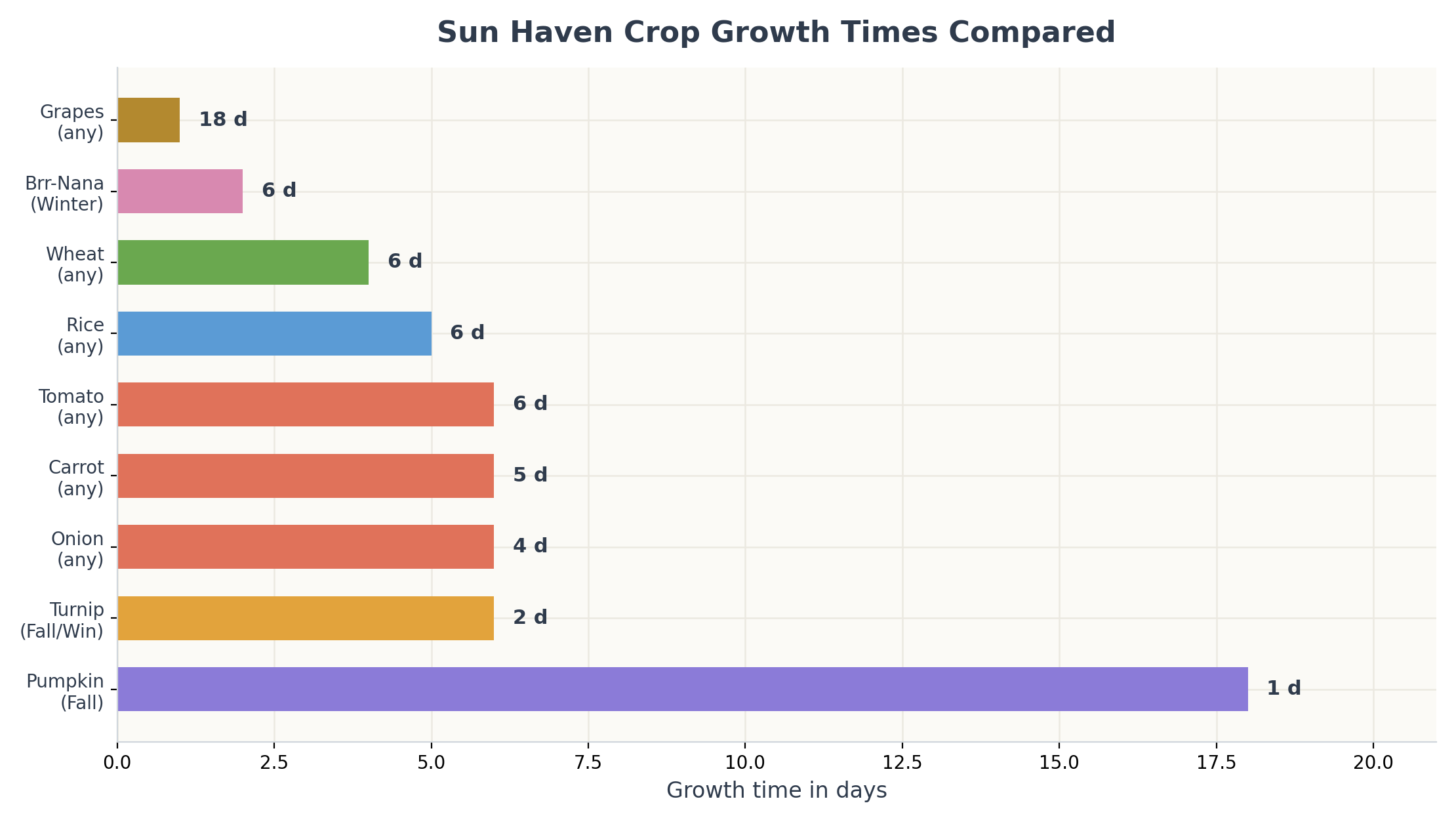
For absolute beginners, Wheat is the safest first investment: it grows in 4 days, costs little per seed, and produces a steady if modest profit. Tomato and Onion take 6 days but return noticeably more gold per tile per day. The trade-off is that year-round crops rarely reach the profit ceiling of the best seasonal crops — players who want to maximize earnings should treat these as the steady base and layer seasonal crops on top.
Spring Planting Window: Days 1–28
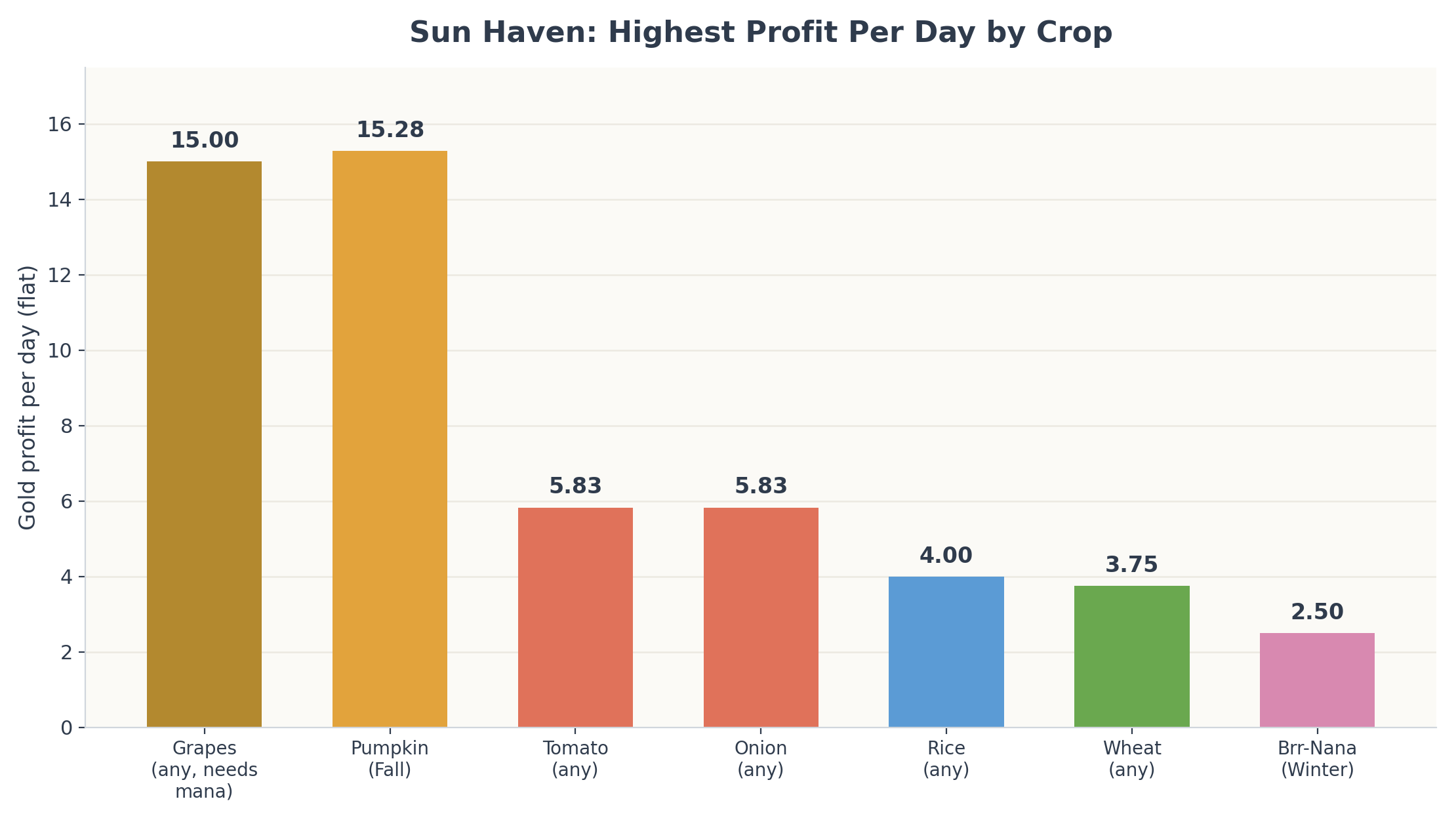
Spring is the season every new farmer should master, because it sets the income baseline for the entire year. The fastest money in Spring comes from Grapes, which mature in a single day and produce the highest daily profit per tile of any crop when players have mana to pay for them. For players without mana to spare, Pumpkin is the standout: although it is often treated as a Fall crop, Pumpkin grows in 18 days and delivers a very strong per-day profit whenever a player is confident of the full window.
Players who want a simple, low-effort Spring routine plant Wheat on Day 1, harvest it roughly four times before the season ends, and reinvest every payout into more fields. As soon as mana is available, shifting those tiles to Grapes roughly doubles the daily return. Before the 28th of Spring, players should harvest everything and clear the field, because Summer crops may catch fire during the intense heat if left planted. A full profit ranking of every Spring option appears in the Spring crops guide.
Summer: Beat the Fire Effect
Summer introduces the first Seasonal Crop Effect of the year: Fire. During intense heat, crops can spontaneously catch fire, and a burning crop stops growing until the flames are put out with a Watering Can or the Rain Cloud spell. This makes fast crops more valuable in Summer, because a 1-day or 2-day crop spends very little time exposed to the fire risk compared with a slow crop.
The strongest Summer plan relies on the same four-season staples — Tomato, Wheat, Grapes, and the newly unlocked Cotton — because their short timers recover quickly from any fire. Players who manage their watering can and mana carefully can still push toward six or seven full harvests of Wheat in the 28-day Summer window. At the close of Summer, players should again clear their fields before Fall, since the coming season shifts the calendar and the weather turns cool. Players who want the detailed profit table for this month can check the Summer crops guide.
Fall: Pumpkin and Turnip Timing
Fall is the season that rewards planning. Pumpkin, the slowest major cash crop in the base game with an 18-day growth time, needs to go into the ground on Day 1 or Day 2 of Fall to finish before the season closes. Because it completes exactly one cycle per season, players must commit a field to it for most of the month and accept that the tile is locked until harvest.
Turnip is the efficient Fall companion, growing in about 6 days, which lets the same field produce roughly four harvests before Fall ends. Players who want variety can split their farm: long-term tiles for Pumpkin and quick-turn tiles for Turnip and any-season staples such as Beet and Wheat. The centering principle remains the same — every seed must clear its growth time before the 28th of Fall, otherwise the gold and the planting window are both lost. A complete ranking of Fall options can be found in the Fall crops guide.
Winter: Brr-Nana and the Cold Downshift
Winter is the hardest season for pure income, which surprises players coming from Stardew Valley. Sun Haven keeps the farm running throughout Winter, but the profitable warm-weather cash crops thin out. The tier-one Winter option is Brr-Nana, which matures in 2 days and becomes a reliable low-effort earner. Turnip also carries over, and year-round staples such as Rice and Wheat keep producing.
Because Winter offers fewer top earners, this is the ideal season for players to shift focus toward the Greenhouse, which lets crops grow regardless of season, or toward the mines and mana-farming routines that do not depend on the calendar at all. Every Winter option is ranked in the Winter crops guide. Players who keep their staples planted and rotate in Brr-Nana across their spare tiles still end Winter with a tidy profit rather than an empty pocket.
Plan Around Harvest Counts, Not Just Profit
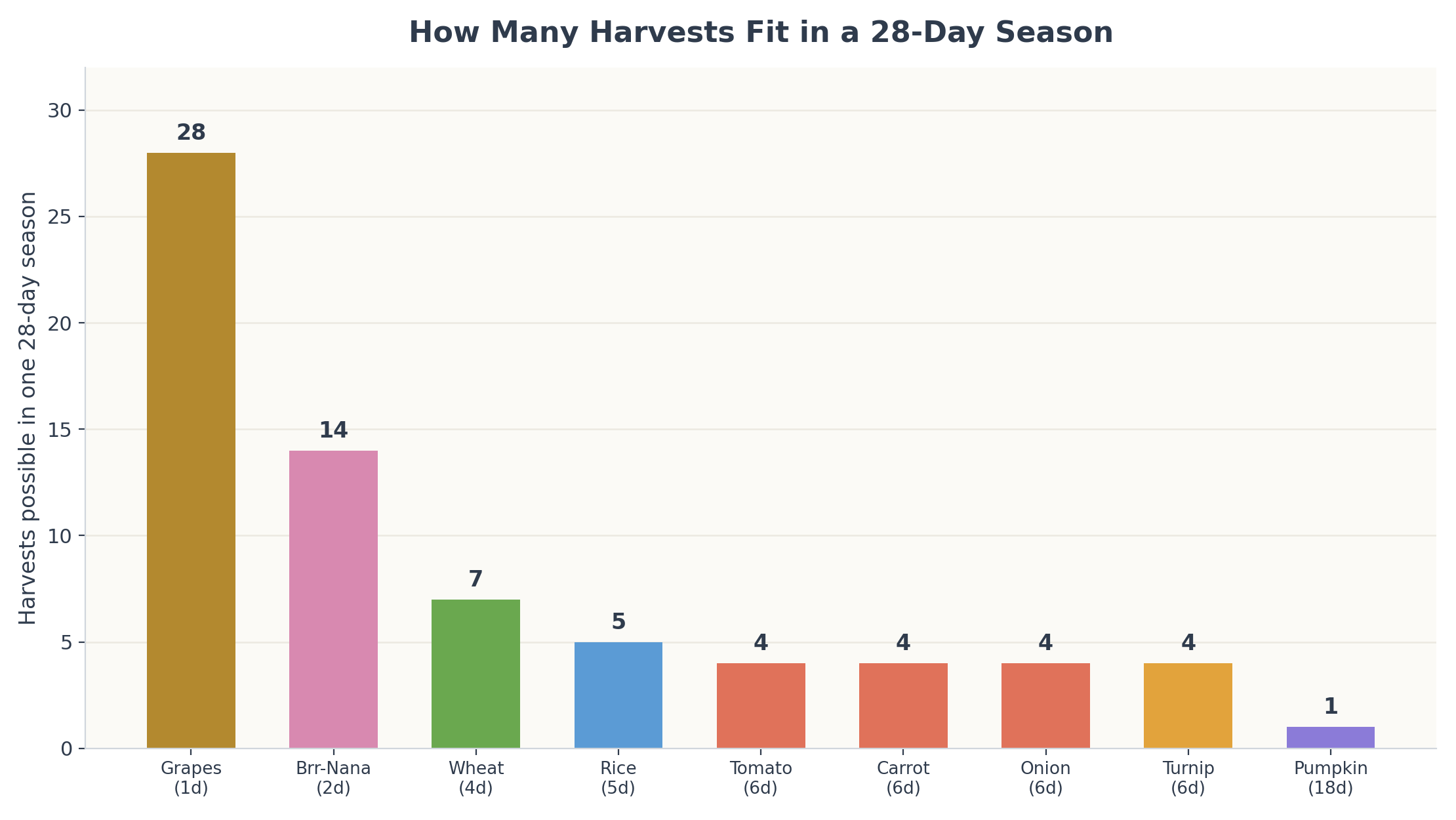
Too many guides rank crops only by per-day profit, but real earnings depend on how many harvests a field can produce inside a 28-day season. A crop that grows in 4 days can yield about seven harvests if replanted constantly, while an 18-day crop yields one. Multiplying per-harvest gold by the number of harvests materially changes the ranking for busy players.
The rule of thumb that works for most farms is a split strategy: devote a small portion of the field to one high-value slow crop such as Pumpkin for a single big payout, and fill the rest with fast crops that produce many small payouts. Players who enjoy a low-maintenance routine prioritize Wheat, Tomato, and Onion; players who chase top gold per day prioritize Grapes and Pumpkin. Both approaches are profitable, and the full comparison of Sun Haven’s best crops for maximum profit per season is covered in the dedicated farm-profit guide.
Season Transition Checklist
The day before a season flips is when farming mistakes happen. Players who follow a short closing routine never waste a tile. Two or three days before the 28th, farmers should stop planting crops whose growth time will not finish before the month ends. On the final day, they harvest everything ready, clear all remaining tiles, and let fields sit empty through the changeover.
This checklist keeps the farm ready for the new season on Day 1 so players can plant the appropriate seasonal cash crop immediately. A player who waits and plants late loses the first real harvest of the month. Following this routine across all four seasons is what turns the Sun Haven calendar from a source of confusion into a reliable gold schedule.
Frequently Asked Questions
How long is each season in Sun Haven? Each season lasts 28 in-game days, and a full year is 112 days. Festivals occur on the 28th, the last day of each season.
What is the fastest-growing crop in Sun Haven? Grapes mature in a single day, making them the fastest base-game crop and a top earner for players with mana.
How long does a Pumpkin take to grow? Pumpkin takes 18 days to mature, so it must be planted on Day 1 or Day 2 of its season to harvest in time.
Can players farm during Winter? Yes. Winter supports Brr-Nana, Turnip, and year-round crops, though players often supplement farming with the Greenhouse, mining, and mana routines.
Do crops die when a season changes? Crops planted in the wrong season, or slow crops planted too late, are lost when the season turns. Farmers should clear all tiles by the 28th.
Related Guides
- Sun Haven Spring Crops Guide
- Sun Haven Summer Crops Guide
- Sun Haven Fall Crops Guide
- Sun Haven Winter Crops Guide
- Best Crops for Max Profit Per Season
- Greenhouse Guide: Build & Best Profit Crops
- Sun Haven Beginner Guide
Love cozy farming games?
Check out our complete Heartopia Guide — mobile cozy town simulation with home building, gardening, and cute neighbors!
🏡 Explore Heartopia →